

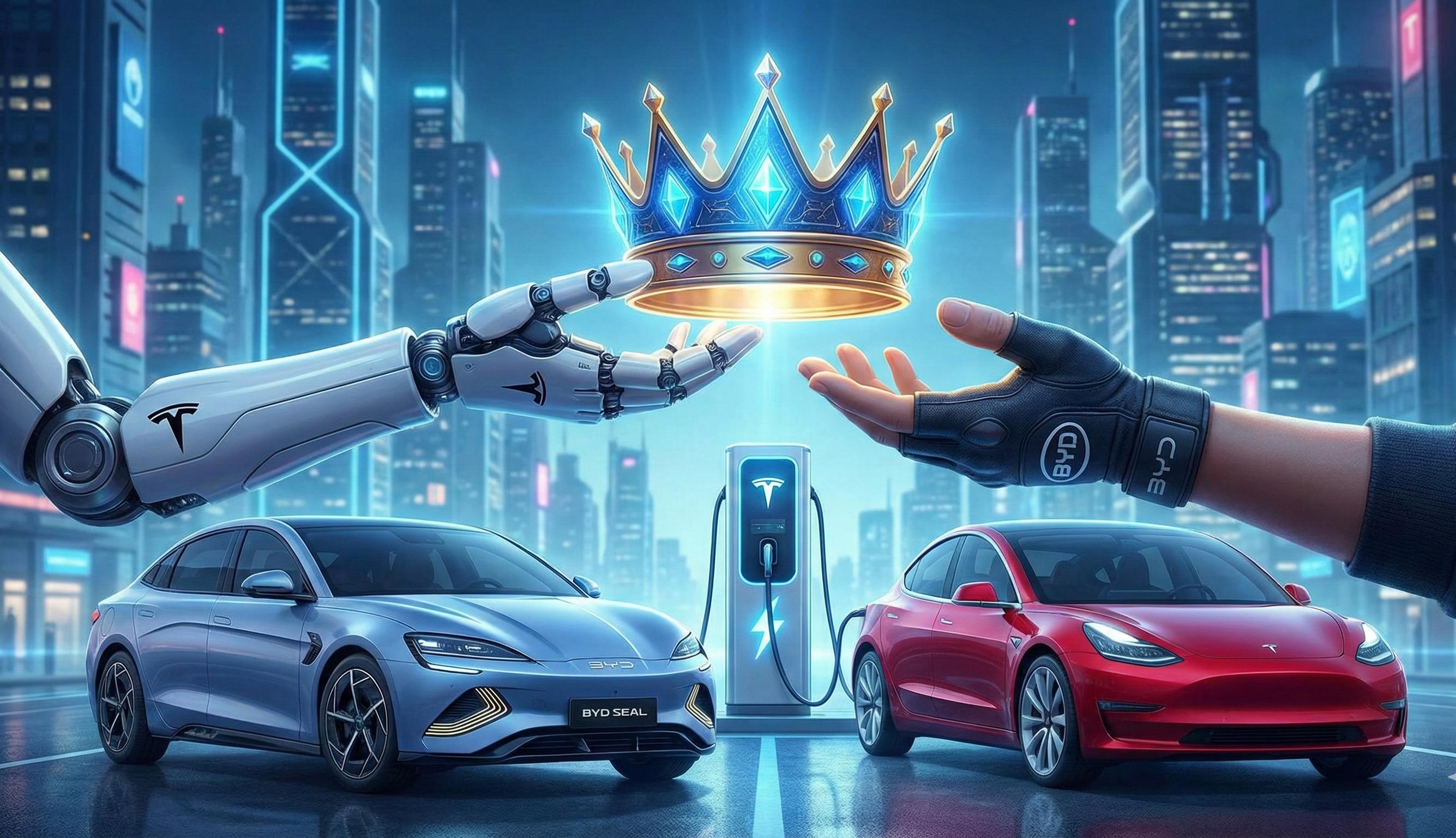
After years of playing catch-up, the Shenzhen-based automaker finally knocked Elon Musk’s company off the top spot—and the gap isn’t even close.
BYD, the Chinese automaker that most Americans still struggle to pronounce correctly, has officially become the planet’s largest electric vehicle manufacturer. The company moved 2.26 million battery-powered cars in 2025—leaving Tesla’s 1.64 million deliveries looking almost quaint by comparison.
For Tesla, this isn’t just a bad quarter. It’s the second straight year of declining sales, with deliveries dropping nearly 9 percent from 2024. The writing, as they say, was already on the wall. Now it’s been carved into stone.
A Tale of Two Trajectories
Here’s what makes this moment so striking: while Tesla contracts, BYD is accelerating.
The Shenzhen giant posted a 28 percent surge in pure EV sales last year. Such growth is not a coincidence. It’s the result of aggressive pricing strategies, a dizzying array of model options, and manufacturing efficiency that’s become the envy of the industry.
BYD’s total vehicle deliveries—including its hybrid and combustion models—grew 7.73 percent overall. However, BYD’s electric business is the driving force behind its success.
Beyond China’s Borders
Perhaps the most overlooked part of BYD’s story is what’s happening outside its home market.
Despite punishing U.S. tariffs explicitly designed to keep Chinese EVs out, BYD has quietly built a formidable presence elsewhere. In Europe, Southeast Asia, and the Middle East, BYD has successfully penetrated unobstructed markets.
The numbers are staggering. Over one million vehicles were sold internationally in 2025. That’s a 150 percent jump from the year before.
Think about that for a moment. A company that barely registered on the global radar five years ago now sells more cars overseas than many legacy automakers sell anywhere.
What Went Wrong in Austin?
We cannot attribute Tesla’s struggles to a single misstep. Production issues, an ageing lineup, increased competition, and—let’s be honest—some self-inflicted wounds from the CEO’s (Elon Musk) various public distractions have all contributed.
The Cybertruck, once hyped as a game-changer, hasn’t moved the needle the way investors hoped. Meanwhile, the Model 3 and Model Y, still the company’s bread and butter, face stiffer competition than ever before.
Price cuts intended to boost demand instead squeezed margins. The formula, which had been effective for a decade, has suddenly become unsustainable.
The Bigger Picture
This isn’t just about two companies swapping places on a leaderboard. It’s a signal—possibly the clearest one yet—that the centre of gravity in the global auto industry is shifting eastward.
China now produces and sells more EVs and is increasingly setting the terms for what the electric future looks like. Western automakers are no longer just competing with Tesla. They’re competing with an entire ecosystem that’s been building momentum for years.
BYD’s ascent to the top spot won’t be the last headline to emerge from Shenzhen. If anything, it’s just the beginning of a much longer story.
