Close Menu
    Advertise With Us
    Facebook X (Twitter) Instagram
    Tuesday, February 10
    Advertise With Us
    Facebook X (Twitter) Instagram
    Greenisthefuture
    • Top Stories
    • Renewables
      • Solar Energy
      • Wind Enegry
    • Electric
      • 2 Wheeler
      • 4 Wheeler
      • Battery
      • Charger
      • Infrastructure
    • Clean Energy
    • Eco Innovator
    • Global
    • Interview
    Subscribe Now
    Greenisthefuture
    You are at:Home » Indian Two-Wheeler Giants Seek EV Subsidy Extension Beyond March 2026
    2 Wheeler

    Indian Two-Wheeler Giants Seek EV Subsidy Extension Beyond March 2026

    SINDHBAJ KUMARBy SINDHBAJ KUMARJanuary 22, 20263 Mins Read
    Share Facebook Twitter Pinterest LinkedIn Tumblr Email
    Share
    Facebook Twitter LinkedIn Pinterest Email

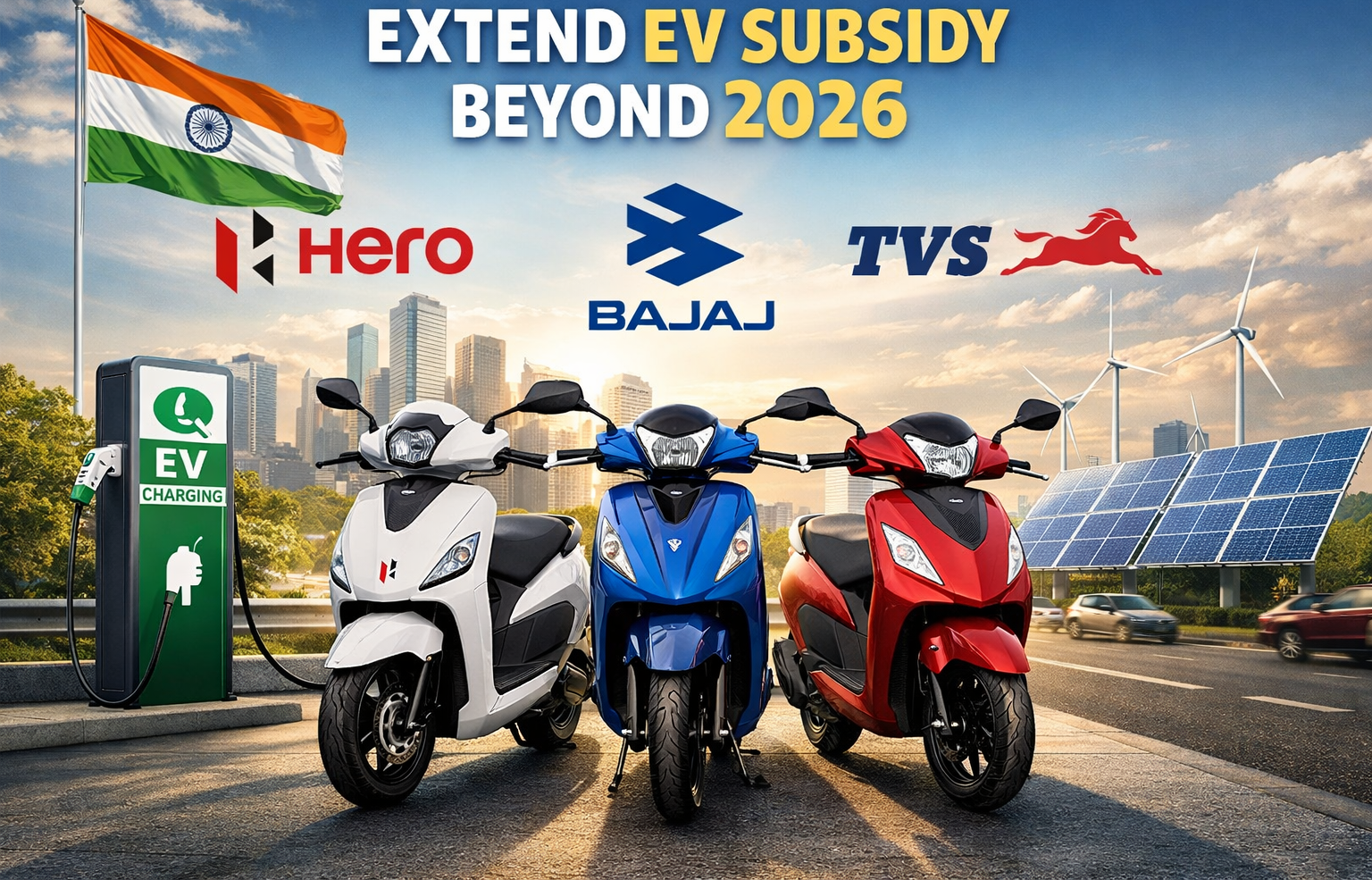
    The two main manufacturers of two-wheelers in India, Hero MotoCorp, Bajaj Auto, and TVS Motor Company, have pressured the central government to expand the existing subsidy programs of electric vehicles (EV) to a later date of March 2026. According to the companies, more time is necessary to use the money allocated optimally and to maintain the same pace of crisis in the adoption of electric two-wheelers in the country.

    Major actors illuminate the problems of market transition

    Industry executives claim that the market of two-wheeler EVs is at the crucial transition stage. Although demand is on the upswing, manufacturers report that price sensitivity by buyers is also high, particularly in the mass market.

    Subsidies have decisively been used to reduce the difference between the costs of electric and internal combustion engine (ICE) vehicles so that EVs are more affordable to the first-time buyer.

    The three companies (Hero, Bajaj, and TVS) have all stressed that a sudden removal of incentives may interfere with consumer confidence and slacken adoption when the market is just getting level.

    Utilization of funds is still incomplete

    The main argument that has been brought out to the policymakers is that a large percentage of the subsidy money cannot be utilized. The manufacturers attribute this to the early policy implementation delays, supply chain delays, and time needed to localize EV components, especially batteries, motors, and power electronics.

    The extension would enable the industry to allocate these funds in a better way, with relation to supporting domestic manufacturing objectives.

    Increase to Production and Localization

    The businesses have further emphasized the fact that such long-term subsidies will promote further localization of EV parts in the so-called Make in India initiative.

    The incentives would also contribute to increasing the production level of manufacturers and investing in innovative technologies and enhancing the EV supply system in India, including battery recycling and charging infrastructure.

    Confluence with the Climate Goals of India

    The industry leaders feel that increasing EV subsidies is relevant to the long-term climate and energy security targets of India. Electric two-wheelers dominate the market in Indian personal mobility systems, and the adoption can be much faster to ensure the substantial reduction of urban emissions and importation of oil.

    The decision of the government is awaited

    Although the government has not officially announced its position, people have been informed that officials are considering industry responses. It is likely to be a critical month ahead because policy clarity will drive investment intentions, product introductions, and pricing plans before the deadline of 2026.

    Bajaj Auto electric mobility electric two-wheelers EV Adoption India FAME Scheme Hero MotoCorp India EV Policy TVS Motor Company
    Share. Facebook Twitter Pinterest LinkedIn Tumblr Email
    Previous ArticleBMW Accelerates EV Push in India, Targets 25% Electric Car Sales by 2026
    Next Article Renewable Energy Stocks Gain Momentum in Market Rebound
    SINDHBAJ KUMAR

    Related Posts

    Budget 2026 prolongs EV Manufacturing industry

    February 2, 2026

    Budget 2026: 4,000 Electric Buses Coming to Eastern India Under Mission Purvodaya

    February 1, 2026

    Budget 2026: Government Extends Duty Relief for Battery Manufacturing, Cheaper EVs on the Horizon

    February 1, 2026
    Add A Comment
    Leave A Reply Cancel Reply

    Top Posts

    BCCI’s Green Pitch for Sustainable Cricket Future

    February 16, 2025

    Global Push for Sustainability Drives Green Ammonia Production

    March 18, 2025

    WPL 2025: Cricket Scores for Sustainability, Too!

    March 14, 2025

    Delhi EV Policy 2.0 Targets 95% Electric Vehicles by 2027

    March 11, 2025
    Don't Miss

    India Enhances International Connections to Increase Renewable Energy and Grid Storage

    By Aditya PandeyFebruary 3, 2026

    The Indian government is increasing its quest to forge international collaboration in renewable energy, green…

    Budget 2026 prolongs EV Manufacturing industry

    Caliber Interconnects Secures ARAI Certification, Boosting India’s EV Charging Infrastructure

    Mercedes-Benz Confirms CLA EV Launch in India for April 2026

    Newsletter

    Subscribe for Updates

    Get the latest updates from GreenIsTheFuture

    About Us

    Green technology can be used to reduce pollution and waste products of traditional industrial processes. In addition to reducing the negative effects on the natural environment, these technologies can also use resources more efficiently.
    Email Us: info@greenisthefuture.in

    Facebook X (Twitter) YouTube WhatsApp
    Quick Links
    • About Us
    • Our Team
    • Privacy Policy
    • Advertise With Us
    • Terms & Conditions
    • Subscription
    Newsletter

    Subscribe for Updates

    Get the latest updates from GreenIsTheFuture

    © 2026 Designed by GreenIsTheFuture.

    Type above and press Enter to search. Press Esc to cancel.