

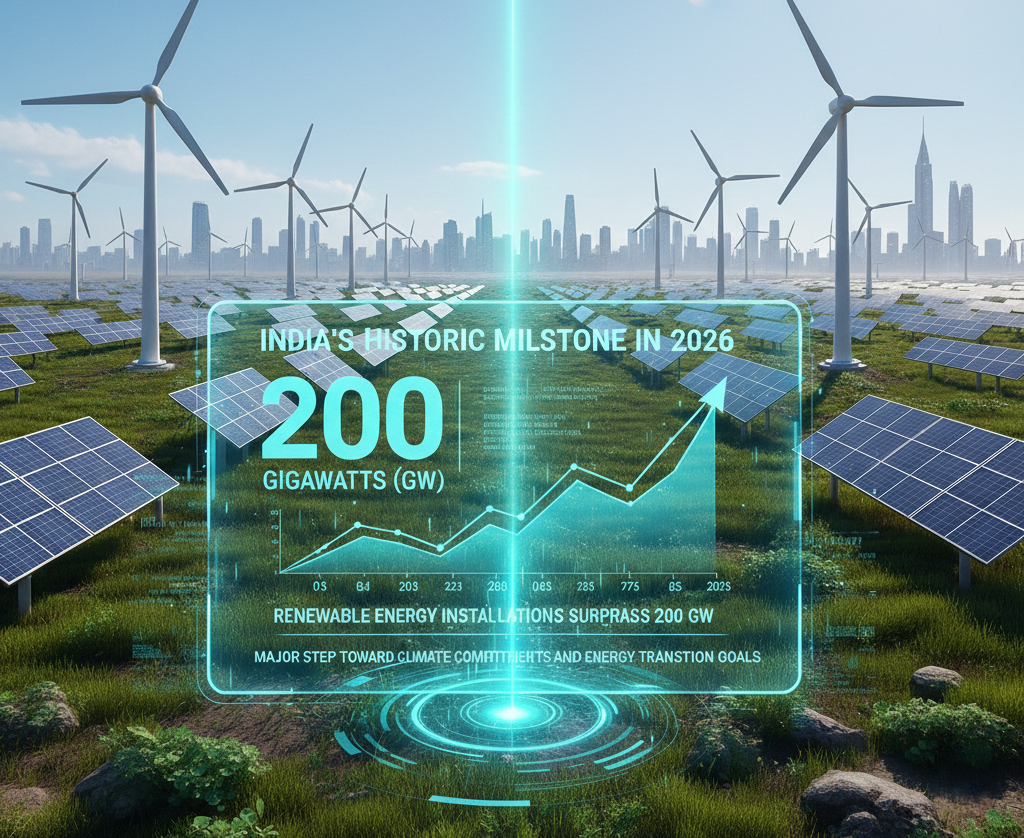
In 2026, the history of India was attained as renewable energy installations reached more than 200 gigawatts (GW). The success is a significant milestone for the climate obligations and energy transition targets of the country.
Landmark Achievement in 2026
With the recent renewable energy capacity development in India, this is now more than 201.45 GW, which contributes to 46.3% of the total installed power generation capacity in India. The achievement of this record indicates years of consistent efforts in solar, wind, and hydro, as well as biomass developments, which makes India one of the fastest-developing clean energy markets in the world.
- The leader in power is solar, with 90.76 GW installed capacity.
- Wind power is next with a figure of 47.36 GW, which has recovered well after a decade of no growth.
- Hydropower and biomass have a large contribution in the total mix.
India on a Drive to Goal on Climate
This success is made possible because India is still working hard to achieve its 2030 goal of 500 GW non-fossil fuel capacity and its 2070 net-zero emissions target. The fact that it has crossed the 200 GW boundary is a clear indication that it is making real steps to go beyond relying on coal and other fossil fuel products.
Key drivers include:
- Competitive auctions and incentives by the government policy.
- Major investments such as Adani Green, JSW Energy, and ReNew Power.
- Technical improvements in the ease of turbine and solar modules.
Renewables Annex of Global Leadership
The renewable process in India is regarded as an example of emerging economies. India is also enhancing its presence in the global energy transition by almost 50 percent of its energy mix being composed of clean energy.
The International Renewable Energy Agency (IRENA) has seen the strides made in India to be significant in global climate action.
The leadership of India in the global forums is focusing on cooperation in technology transfer, cheap finance, and capacity building.
Challenges Ahead
The milestone notwithstanding, there are challenges:
- Grid integration and bottlenecks in transmission remain a slowdown in deployment.
- Acquisition of land is a challenge to the massive solar and wind projects.
- The financing risk continues to be a menace to the smaller developers as compared to those who are conglomerates.
Looking Forward
Not only does the renewable industry in India recover but it also gains momentum in 2026. India is on a sure path to transform its energy sources, with the capacity almost doubling to 119.5 GW of wind power alone by 2031, with solar clearly leading the pack.
Conclusion
It is beyond merely the numbers; it is more of an intention to go beyond 200 GW in renewable energy installations in 2026. India is demonstrating that clean energy on a large scale is a possibility that should be adopted, and this makes a more sustainable future attainable.
