

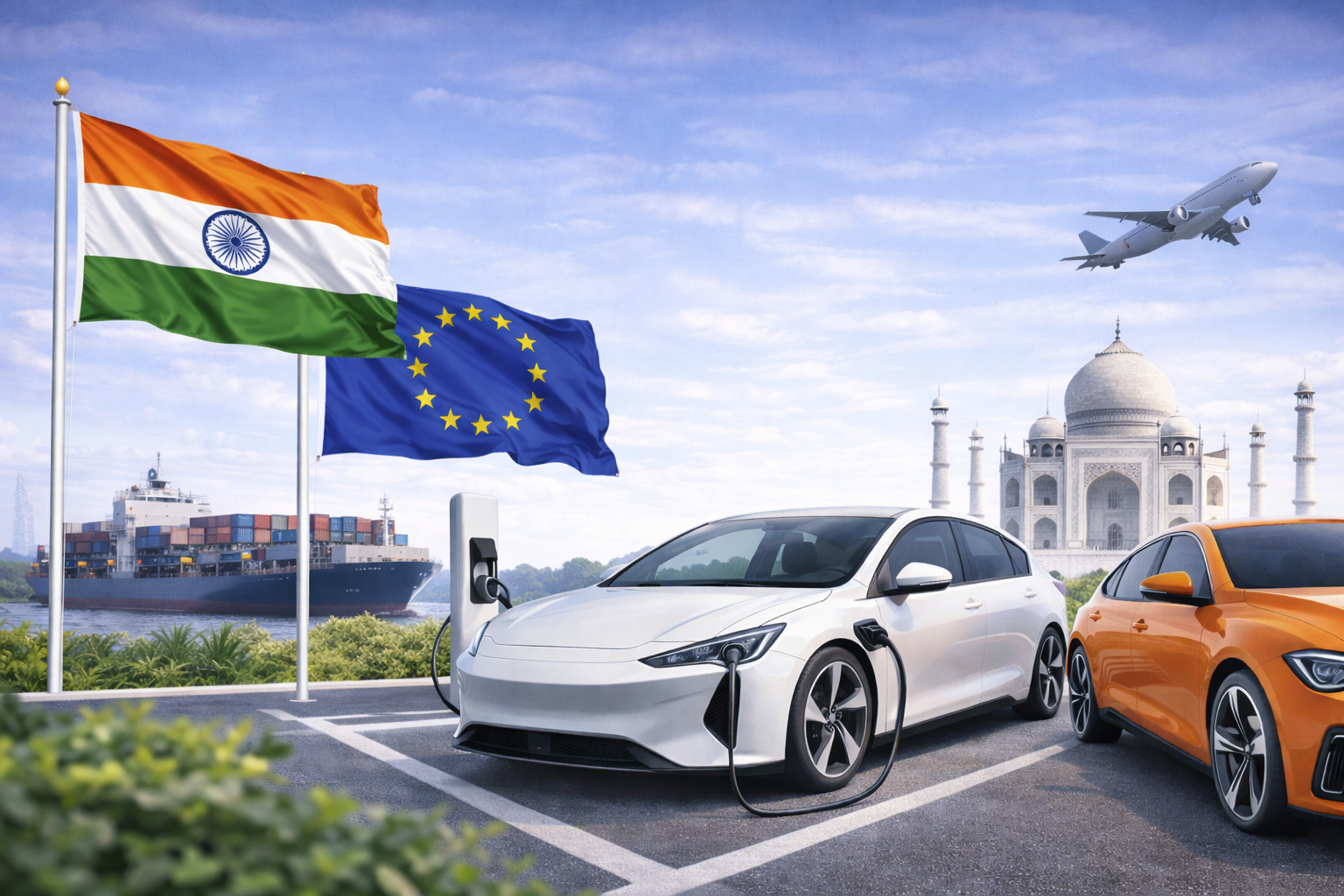
The Indian government and the European Union are on the verge of signing a free trade agreement that could disrupt the country’s electric vehicle market.
The agreement will lead to a reduction of import tariffs on European vehicles by 10-15%, which will lower the price of luxury EVs produced by such companies as BMW, Mercedes-Benz, and Audi.
This will be announced, probably in a bilateral summit on January 27.
What Changes for Buyers
At the moment, India imposes close to a 100% import duty on vehicles costing above 40,000, equivalent to approximately 37 lakh rupees. That makes European luxury EVs very costly for Indian customers.
Once the FTA takes effect, it will reduce these taxes on European electric cars. Lower taxes will lower showroom prices, encouraging more buyers to shift towards high-quality electric vehicles.
India is a market that European automakers can now consider pursuing.
Local Companies remain insured
The deal does not leave Indian manufacturers alone. Homegrown manufacturers such as Tata Motors and Mahindra, which deal in affordable EVs, will still maintain their position.
India has various rules under its EV policy that European brands must adhere to to enjoy lower duties. That is the acquisition of 25% of components in the third year and 50% in the fifth year.
This arrangement prevents imports that would undermine India’s manufacturing goals but still allows foreign investment.
Industry Welcomes the Move
Hardeep Singh Brar, the president and CEO of BMW Group India, believes that the deal will be a win-win.
It will enhance business, technology exchange, and innovation. This mix of strengths will drive luxury car consumption in India and enhance supply chain integration, he added.
Luxury EV Market Small, but Growing
India’s luxury EV market is small, with sales of only about 2,000 vehicles annually. But things are shifting.
Jato Dynamics reported that battery-electric cars accounted for 10.7% of luxury car sales in January-November 2025. It is over twice the 4.5% market share in the mass-market segment.
The mainstream market is dominated by petrol and diesel, but high-end brands are placing high bets on the hybrids and plug-in models as a transition to full electrification.
