

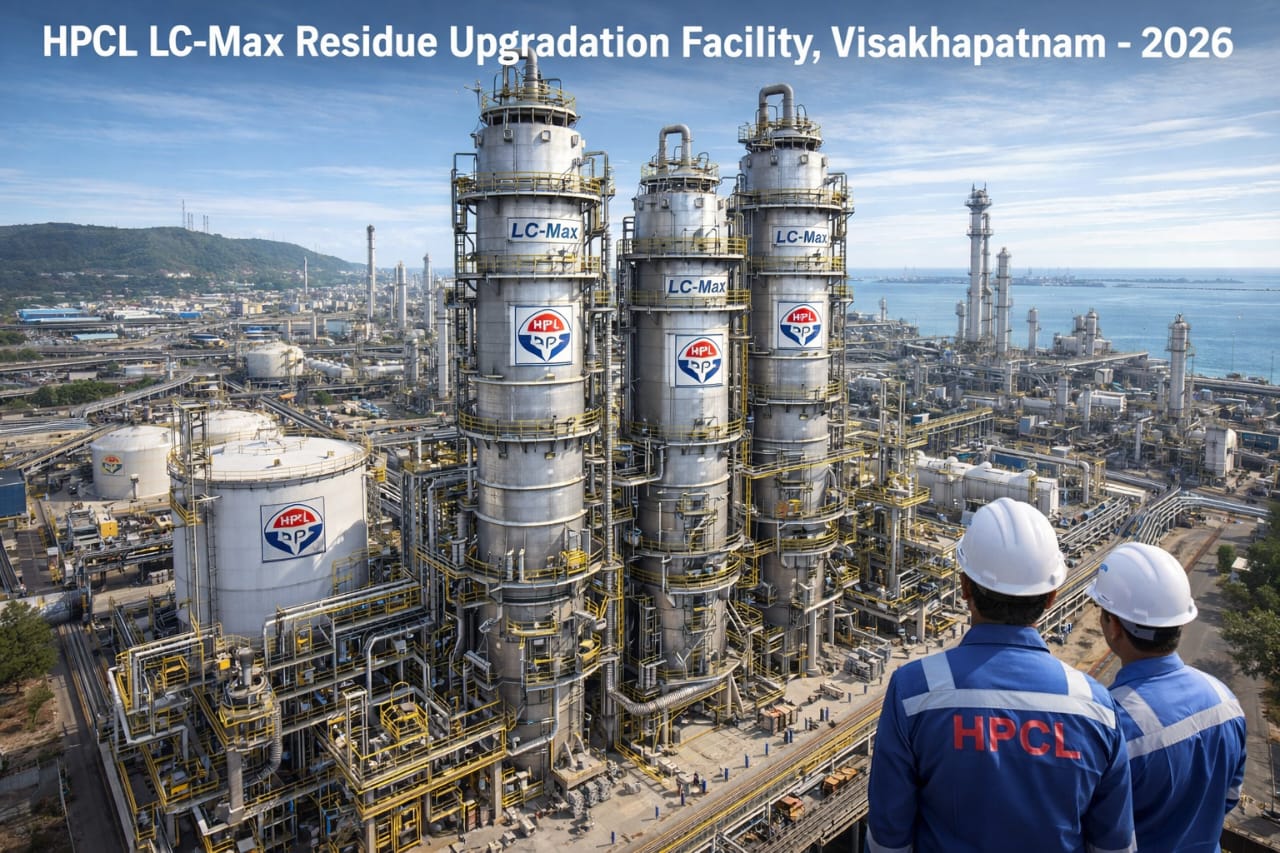
This week, the most modern refining plant in India—the Residue Upgradation Facility (RUF) at the Visakhapatnam refinery of Hindustan Petroleum Corporation Limited (HPCL)—was commissioned, the first LC-Max in the world. The 31,407 crore project is a milestone in the energy security strategy of India; it will bring efficiency in refining, decrease dependence on crude imports, and make the country self-sufficient in fuels.
Commissioning Details
- Date: January 5, 2026
- Position: HPCL Visakh Refinery, Visakhapatnam, Andhra Pradesh.
- Cost of project: 31,407 crore for the Visakh Refinery Modernization Project (VRMP).
- Technology: Liquid Conversion-Maximum (LC-Max) Residue Upgradation Facility in the world.
- Capacity: 3.55 million tonne per annum (MTPA)
- Engineering: Scale three LC-Max reactors, of the heaviest type in the world.
Strategic Significance
The RUF allows HPCL to upgrade low-value residual oils to high-value petroleum products with great success in enhancing margins and fuel production. This enhanced ability of deep conversion makes India more complex in refining, which suits the government vision (Atmanirbhar Bharat).
- Energy security: Minimizes foreign dependencies on fuels through exploiting as much as possible of the domestic crude.
- Efficiency: Enhances the yield of distillates to cleaner fuels such as diesel and aviation turbine fuel.
- Innovation: Indigenous LC-Max technology, which is the first of its kind with digital optimization systems to ensure consistency in operations.
Industry Context in 2026
The refining industry of India is also being modernized to comply with the standards of Euro-VI emission and the increased local domestic demand.
The Visakh RUF reinforces the status of India as a refining hub in the world and augments movements at Jamnagar and Paradip.
Since the crude import dependency is close to 85, initiatives such as RUF are important in mitigating the exposure to oil price fluctuations in the world market.
The commissioning is in line with India aiming to commit 500 GW of non-fossil fuel by 2030, where fossil fuel efficiency and growth of renewables are to be balanced.
Local & National Impact
- Employment: Thousands of jobs generated in the course of construction and constant operations.
- Home manufacture: Some vital parts were also manufactured in India, and this demonstrates engineering independence.
- Regional development: Visakhapatnam becomes one of the major energy centers, drawing downstream investments and industries.
Conclusion
The opening of the Residue Upgradation Facility of HPCL in Visakhapatnam is a milestone in the Indian energy reforms. Through the introduction of the first LC-Max unit in the world, HPCL has improved efficiency in refining as well as driving the Indian nation towards energy independence and sustainability.
This project will become one of the foundations of the balanced energy strategy in India as 2026 approaches, as modernization of the fossil fuel infrastructure will be happening, and the implementation of clean energy will be sped up.
