

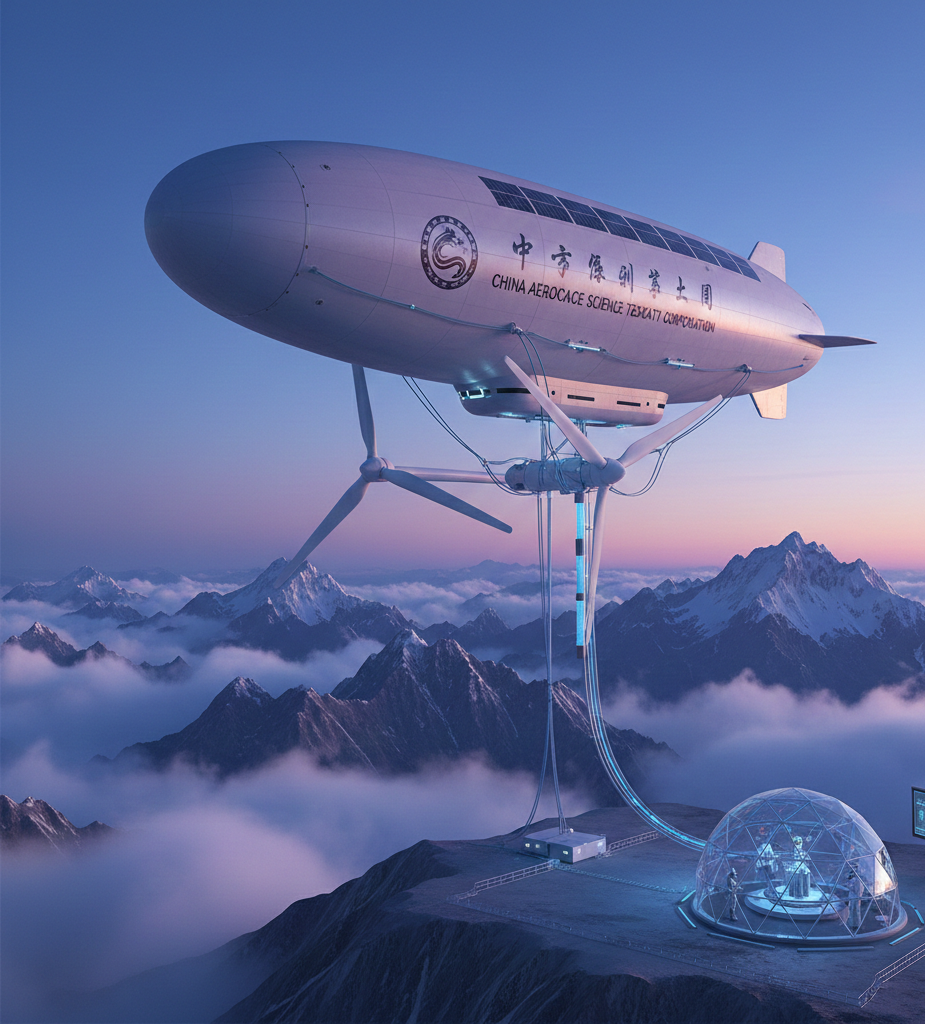
A key milestone in the innovation of renewable energy was one made by China with the successful testing of the first ever megawatt level air ship airborne wind power airship in the world. The experimental system was raised to the height of 6,560 feet (2,000 meters) and connected the electricity directly to the power system, proving the commercial viability of high-altitude wind energy.
Beijing Linyi Yunchuan Energy Technology conducted the test flight on January 5 in the Sichuan Province in Yibin. It is the inaugural megawatt-level airborne wind system to have a stable grid-connected power generation.
The mechanics of the so-called windmill airship.
The system is called the S2000 Stratosphere Airborne Wind Energy System (SAWES) and is a large helium-filled airship that includes wind turbines. The airship has a length of about 60 meters, width of 40 meters, and the height of 40 meters. The system is positioned on high altitude unlike the traditional wind turbines that are set on towers since the winds are more powerful and steady.
The airship is of ducted air flow type, in which wind is diverted between the main envelope and circular wing structure. This squeezes the air before it goes to the turbines thus greatly enhancing power generation.
Power generation and grid connection.
Throughout the trial, the airship took off progressively with a duration of 30 minutes and hung at its target height. During air, it produced approximately 385 kilowatt-hours of electricity, which was sent to the ground through tethered cables and supplied to the local power grid.
The engineers working on the project make the observation that the potential of wind energy grows exponentially with the speed of the wind. The wind speed at an altitude of 2000 is often many times greater than that of the ground, so the system is capable of generating more power with less material.
Business opportunities and prospects.
The developers believe that the SAWES platform should have a power rating of up to 3 megawatts. Small scale production is already in progress and there has been expression of interest by the coastal areas, mountainous and remote areas where installation of traditional wind turbines is a challenge.
A special production hub at Zhejiang Province is already being ready to aid future deployment. Although additional tests will be needed to resolve safety, durability and cost issues, the successful grid-connected flight is a big step towards the commercialization of the airborne wind power technology.
