

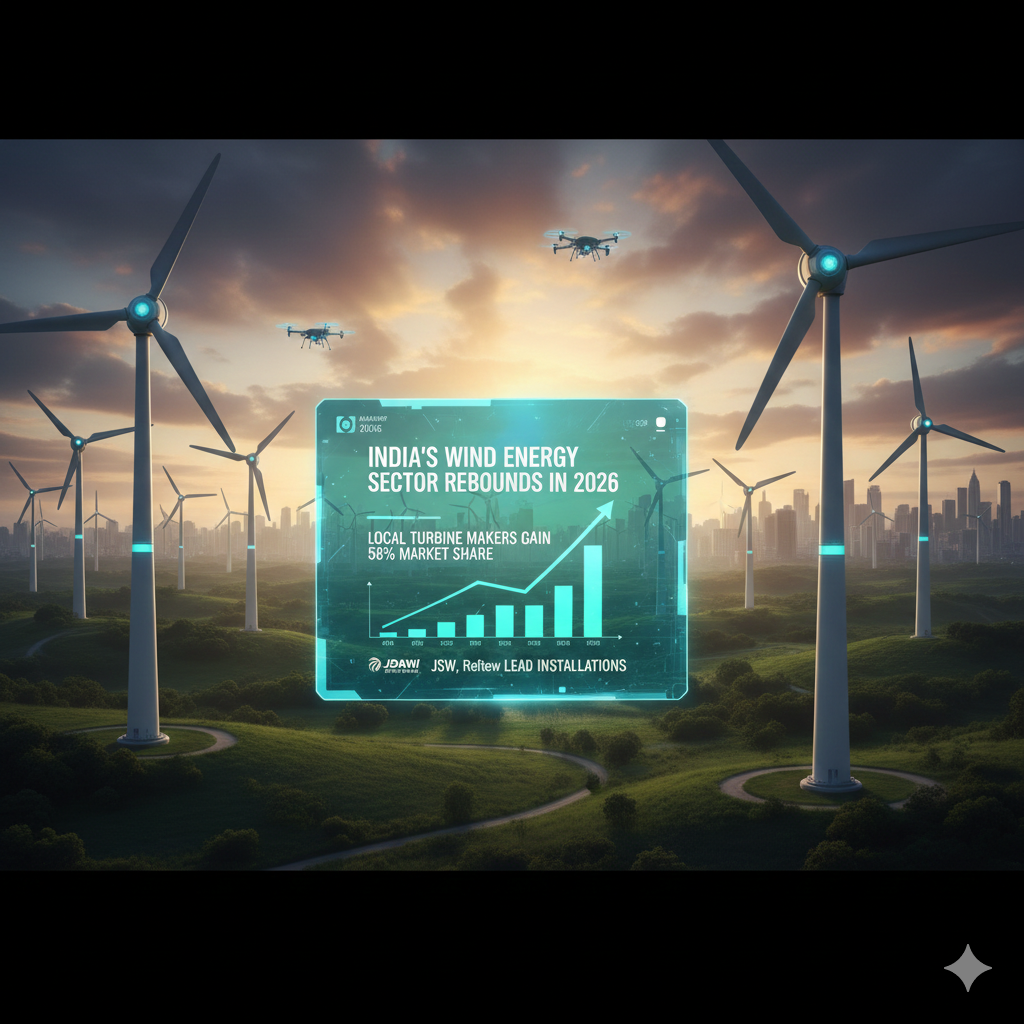
The Indian wind energy industry has been characterized by a robust recovery in 2026, when the local turbine manufacturers established more than 58 percent market share, and the large renewable market players were in the process of inducing fresh installations.
Manufacturers in the Area Bounce Back
Suzlon and Inox Wind have gone back to profits following years of losses.
It is now time to show confidence in homegrown technology, with domestic turbine makers now having 58% of the market share.
The rebound of the sector is based on several years of stagnation since competitive bidding, and not feed-in tariffs, entered into force in 2017, and investments were slowed by the pandemic.
New installations are dominated by big players
New winds within India are being led by Adani Green, JSW Energy, and ReNew. These businesses contribute most of the new capacity additions and cement their position as pioneers in the transition to renewables in India.
In 2025, the clean-energy business managed by Adani recorded the highest growth since it has increased wind and solar developments.
Market Outlook for 2026
The capacity, i.e., the installed electric power of wind, is expected to be 59.5 GW in 2026 and almost double in 2031 as 119.5 GW. There is a projected 14.97% CAGR of the sector between the years 2026 and 2031 attributed to conducive policy and company investments.
Even at a very early stage, offshore wind projects are becoming popular as an extension of long-term energy diversification in India.
Key Drivers of Growth
- Government drive: India’s renewable energy goals focus on wind as one of the vital pillars to be used along with solar.
- Corporate need: Massive industrial buyers are placing long-term power purchase contracts to achieve the sustainability objectives.
- Technology renewals: New technology in the form of a new turbine that is more efficient and cost-effective is lowering costs.
Challenges Ahead
Integration into the grid is still a challenge, and the bottlenecks of transmission reduce the deployment. The issue of financing is still in place, and this is more so among small developers against large conglomerates.
The problem of land acquisition is still stalling a few projects, especially along the coastal areas and rural areas.
Industry Voices
According to Suzlon and Inox Wind executives, local production does not have to rely on imports and enhances the Indian power autonomy. Analysts observe that the hegemony of Adani, JSW, and ReNew may transform the competitive landscape that will compel smaller companies to pursue niche markets or mergers/acquisitions.
Conclusion
The wind energy industry in India in 2026 will not be in the recovering mood anymore; it will be gaining momentum. Local turbine manufacturers have regained the market share, and big players such as Adani Green, JSW Energy, and ReNew installations are leading the new installations. Wind energy is set to form the backbone of Indian renewable energy, as the capacity is expected to nearly double by 2031.
