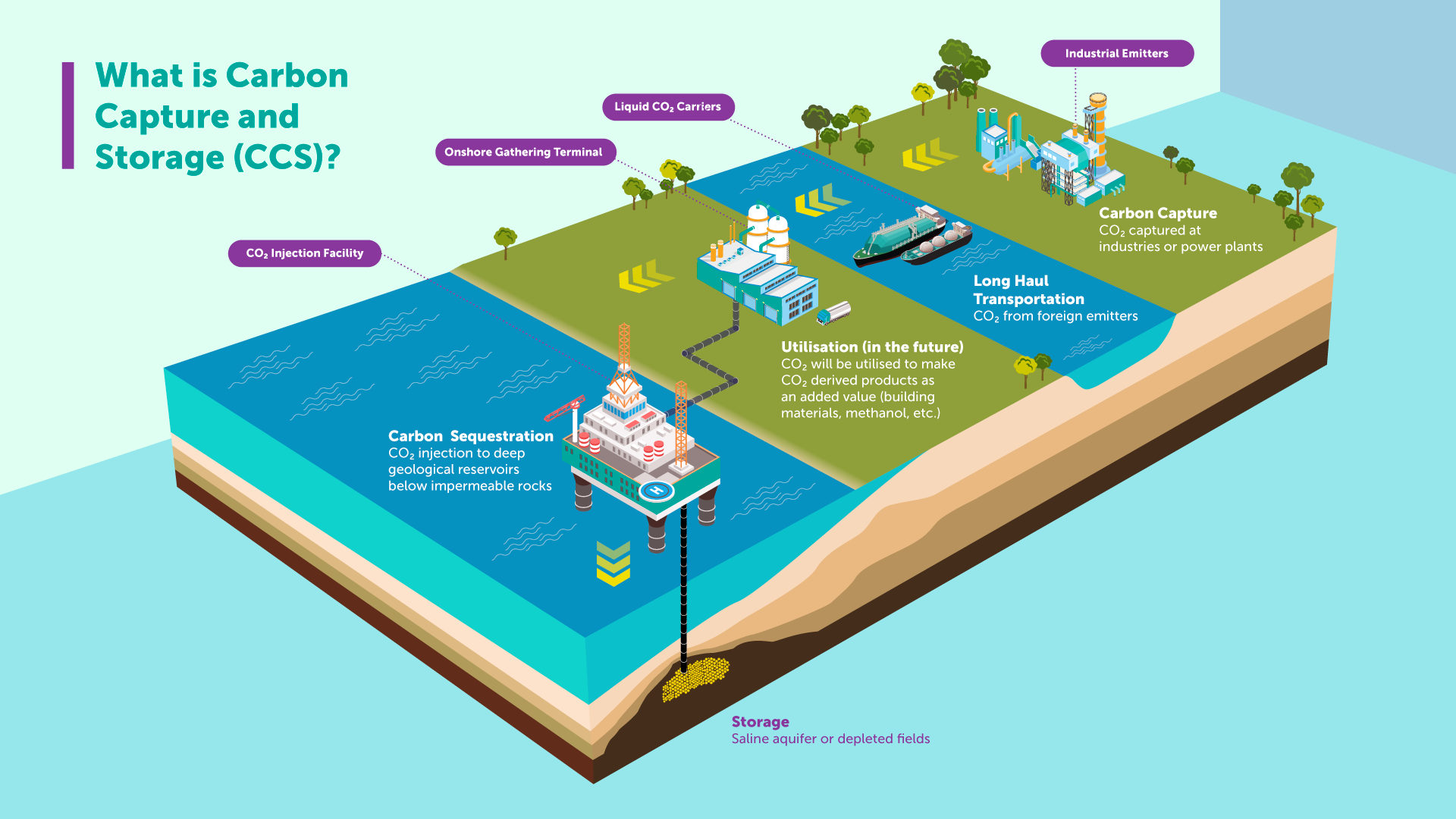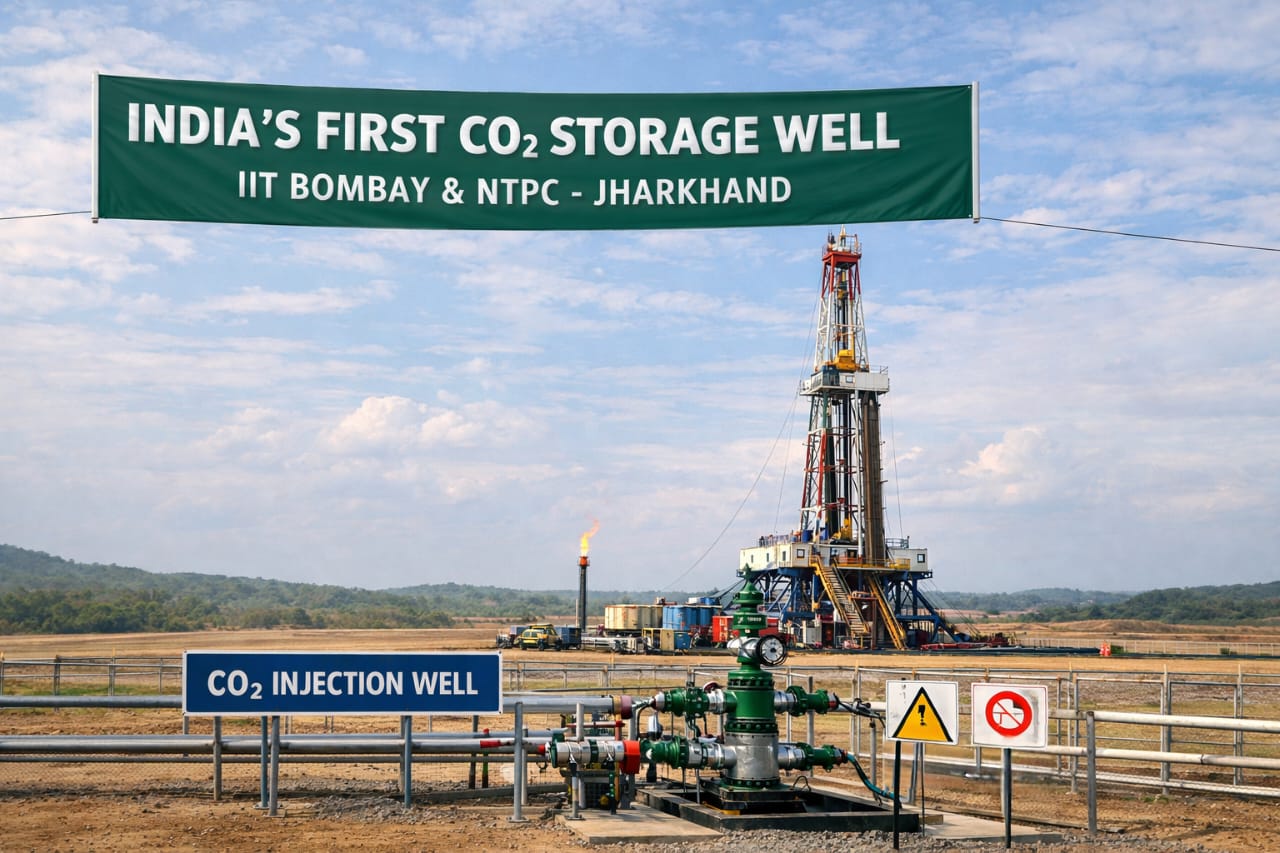
This is a significant milestone in the clean energy process in India, with IIT Bombay and NTPC managing to drill the first well in the country that is used to store CO₂ in Jharkhand. The project, which is to be completed in November 2025, is a technological milestone in Carbon Capture, Utilization, and Storage (CCUS) technology, which puts India on the road to net-zero.
India’s First CO₂ Storage Well
The first attempt was completed at Pakri Barwadih, Jharkhand, which is close to the mines of coal operated by NTPC. The well was sunk to a depth of 1200 meters, and its area of focus was the sedimentary rocks like coal and sandstone; these have been deemed to be excellent underground storage of carbon dioxide.
Key facts
- Partners: IIT Bombay (implementation agency) and NETRA, the R&D wing of NTPC.
- Launch date: Co-operation started in November 2022 under the auspices of NITI Aayog.
- Completion: The first well to be drilled and completed on November 15, 2025.
- Second well: It is being drilled nearby to measure CO₂ injection and containment.
Why It Matters
One of the vital technologies is Carbon Capture and Storage (CCS) to alleviate greenhouse gas emissions through capturing the CO₂ emitted by industries and storing it at underground levels rather than discharging it to the atmosphere.
The net-zero of India that needs to be achieved by 2070 will demand mass use of the CCUS.
The Jharkhand project is part of the construction of the first geological storage atlas in India and of mapping potential underground reservoirs of the CO₂..
A success in this case would open the way to indigenous CCUS solutions, which will minimize dependence on imported technologies.
Academia-Industry Collaboration
The move underscores the necessity of academia-industry collaborations as an approach to addressing climate issues. The scientific research is headed by the Department of Earth Sciences of IIT Bombay, and industrial expertise and infrastructure are supplied by NTPC. There are different approaches to monitoring used in the project to observe the behavior of CO₂ underground.
It will assist in setting safety measures, as well as long-term sustainability of geological storage in India.
The partnership will also be empowering in stimulating other projects in coal-abundant states.
Future Outlook
Analysts feel that this initiative would be a game changer in the Indian energy industry. NTPC is the largest power producer in the country, so the implementation of CCUS would help to reduce the emissions greatly.
In the event of a success, India can increase CCUS in all the thermal power plants, steel, and cement factories.
Jharkhand wells will be a guinea pig to the commercial projects in the future.
This breakthrough makes India much stronger in the global climate negotiations, as it demonstrates tangible steps towards the reduction of emissions.
Conclusion
The first CO₂ storage well in India to have been drilled in Jharkhand by IIT Bombay and NTPC is not just a scientific feat but a strategic move in the direction of sustainable energy. With monitoring going on, the project may provide the basis of the large-scale carbon capture infrastructure in India, which will guarantee cleaner growth and achieve its climate targets.