

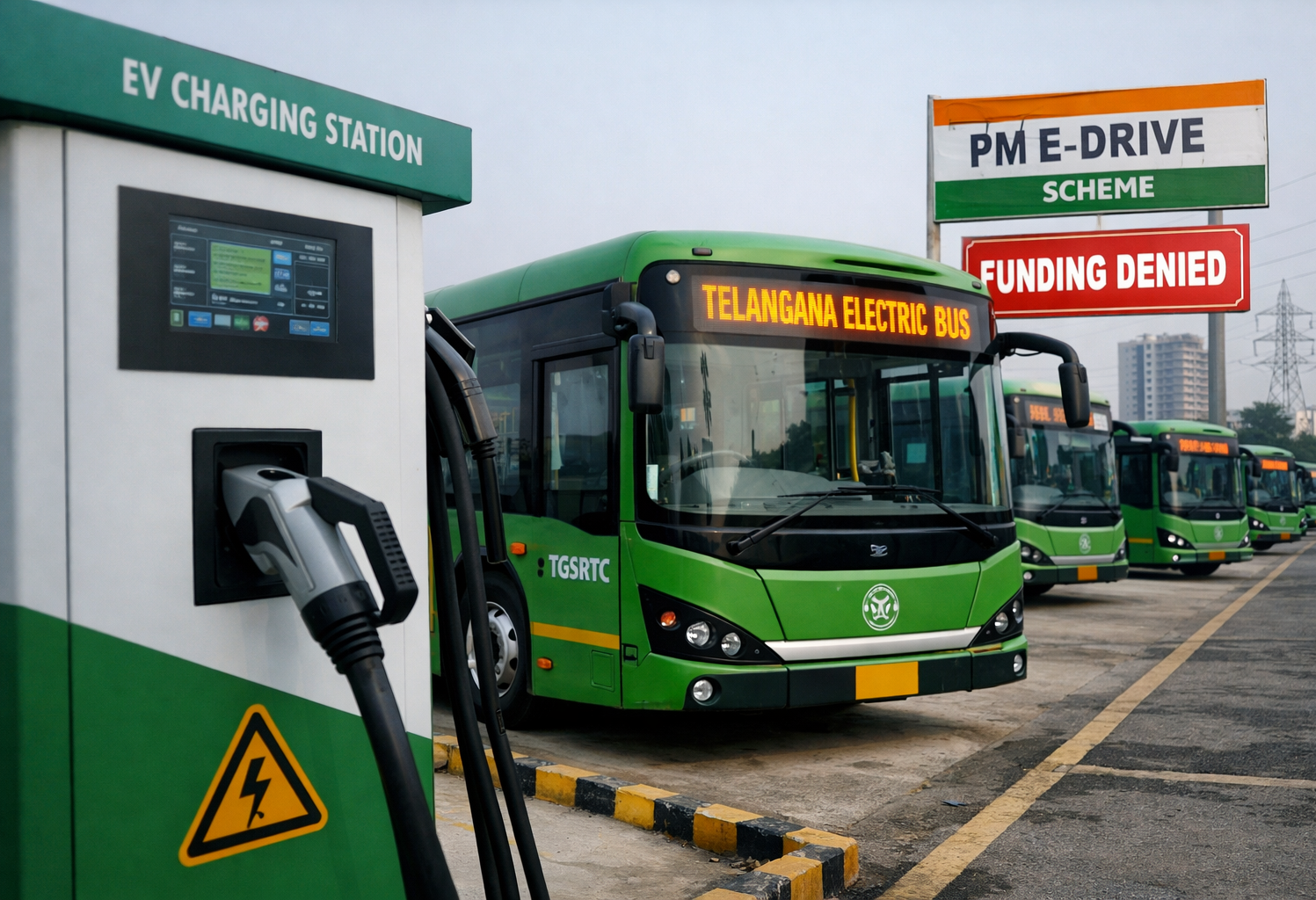
The ambitious proposal of Telangana to roll out 2,800 electric buses in the entire state under the PM E-DRIVE scheme of the center has been a big setback in policy, and this act has delayed the major part of the clean transport drive in the state region and also raised the point of disagreement between the state and central governments.
Conflict between Hybrid Model and Central Guidelines
The Telangana government, in a bid to modernize the public transport and protect jobs, suggested a platform consisting of the Hybrid Gross Cost Contract (Hybrid GCC) model to roll out the electric buses.
In this model, the bus manufacturers would provide the electric vehicles, with the state-owned Telangana State Road Transport Corporation (TGSRTC) remaining with the operation and maintenance responsibilities as compared to the entirely outsourced model, which is the preferred one at the national level.
The PM E-DRIVE scheme, however, is now extending just a standard Gross Cost Contract (GCC) where the procurement and operation are combined under a central agency, Convergence Energy Services Limited (CESL), involved and subjected to the same national guidelines. The hybrid model in Telangana is not in compliance with these rules, and hence the state proposal does not qualify as central funding or scheme benefits.
The retrofitting proposal was rejected as well
The state government also proposed retrofitting old diesel buses into electric buses in a move to reduce the cost factor. This, however, could not be used under existing PM E-DRIVE provisions, which can solely help in procuring the new electric bus under special contract conditions.
Greater Policy Responsibilities of E-Mobility
The stall also highlights a more general conflict between the Centre’s ambition of standardized and scalable electric mobility frameworks and state interests of local employment and operational control.
The transport leadership of Telangana perceives that their model could save the citizens and the jobs of the public sector and help to integrate services better, whereas the central guidelines are focused on efficiency and uniformity.
What Comes Next
The officials on both sides are to benefit from more talks aimed at considering possible changes that may close the policy gap so that the state may receive funding while achieving its electrification objectives.
