

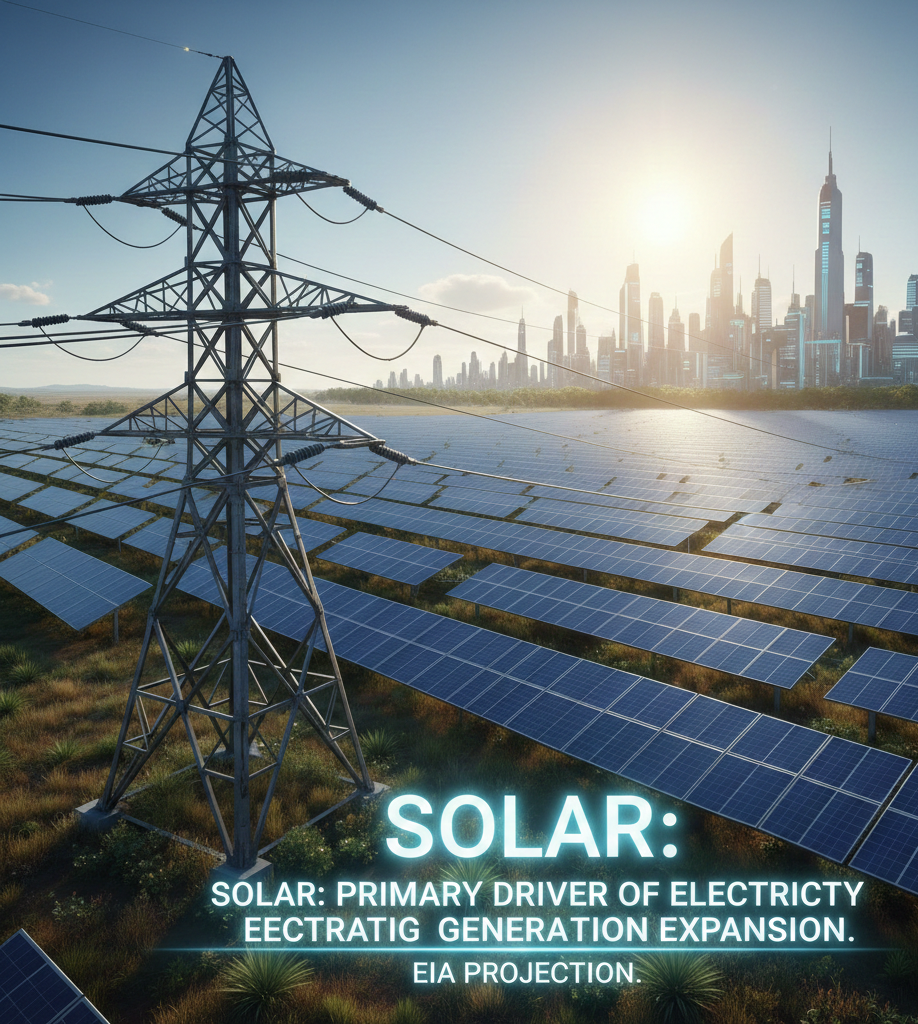
The recent projection by the US Energy information administration (EIA) indicates that solar energy will take the center stage in spurring electricity production expansion over the two years to come. According to the agency, the quicker solar capacity additions will supersede nearly all other types of power generation, which supports the claim that solar is the fastest-growing section of the electricity mix.
Solar Leads in New Capacity additions.
The EIA anticipates that most of additional electricity generation capacity until the near future will be through solar power facilities, with the decreasing technology costs, favourable federal and state policies, and high corporate interest in clean power. Large scale solar facilities, as well as distributed rooftop systems, are expected to play a key role in the development of power generation in total.
The input in the electricity generation growth is provided by the fossil fuel source .The fossil fuel source offers a contribution to electricity generation growth .
Although aggregate demand in electricity is projected to increase by a moderate percentage within the next two years, the contribution to solar generation is set to take a big portion of the incremental supply. The EIA observes that the increase in solar output will be exceptionally high when it occurs on maximum daylight hours, which will assist utilities to satisfy the increased demand by the data centers and electric vehicles, as well as electrification of buildings.
Wind and Gas Also Play Roles
Besides solar, it is anticipated that wind power will help to improve the growth of electricity generation, albeit at a slower rate than has been observed in the recent years. Generation powered by natural gas will continue to be a significant balancing generation, particularly when demand is elevated, or when renewable source production is low. Nevertheless, the EIA shows that the growth of gas generation will be constrained relative to the solar one because of the volatility of fuel prices and rising competition of renewables.
Impact on Coal and Emissions
With the growth of solar and other renewables, generation of electricity through coal is likely to keep decreasing in the long term. Higher renewable production is also expected to cut down the carbon dioxide emission of the power sector despite higher overall electricity demand creeping. The EIA points out the fact that in the forecast period, solar development will play a major role in ensuring that the emissions are kept in check.
Outlook
The future prognosis of the EIA highlights a paradigm change in the power sector, where the main force in the new electricity generation will be solar. Solar power will increasingly contribute to the future electricity demand and contribute to the energy security and decarbonization objectives as grid operators invest in storage, transmission, and flexible resources to support their demands.
