

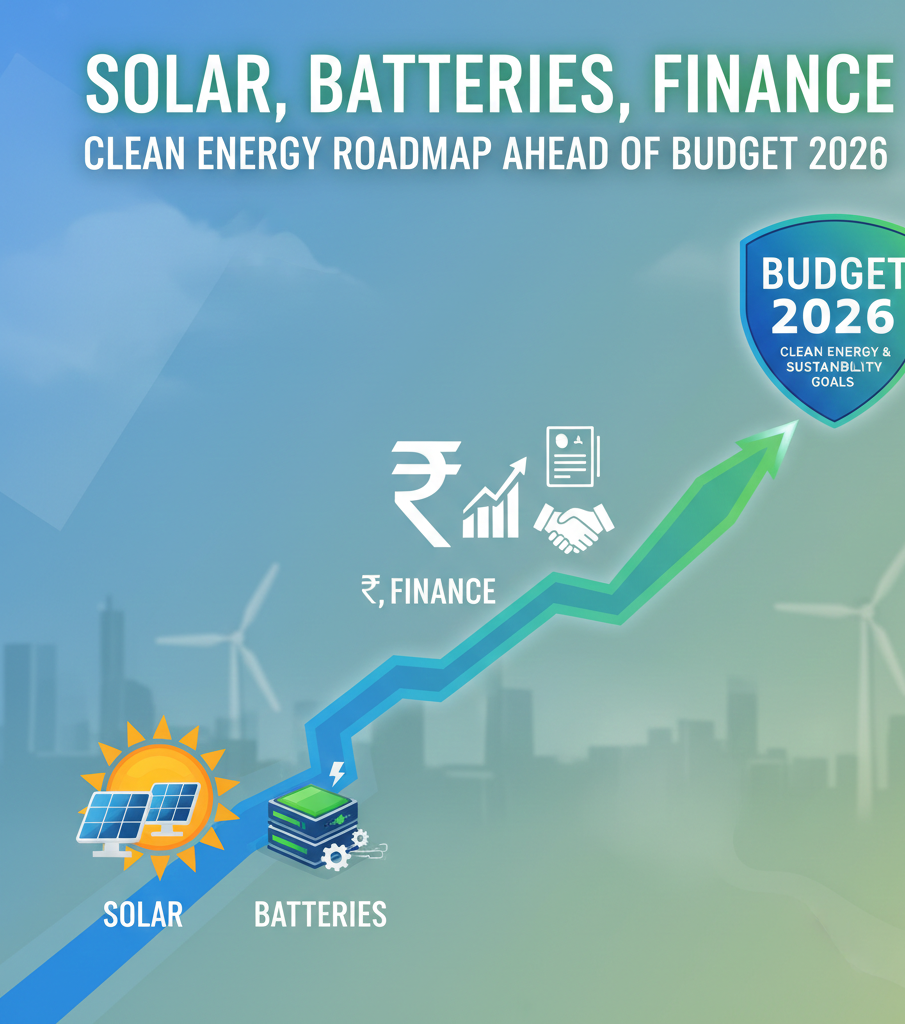
The Financing of Renewable Energy: Solar Finance, Storage, Green Finance, What Do Renewable Energy Players want in the Budget 2026.
With the Union Budget 2026-27 on the anvil, the renewable energy industry in India is pressing on aggressive policy provisions to speed up the clean-energy transition of the Indian nation. Given that the Budget is set to become available on 1 February 2026, industry participants explain that this is an important time to start solidifying the process of solar implementation, adopting energy storage, and providing green funding at low costs.
According to industry stakeholders, although India has been keen in adding renewable capacity, the next stage of development should be on the execution assurance, and competitiveness of the domestic manufacturing and reduction of the cost of capital. In their opinion, now the ability to maintain the momentum rests on how well the Budget is dealing with these structural challenges.
Distributed Generation and Solar Power.
Solar energy remains the staple of the clean-power policy in India. There should however be incentives as developers insist, but beyond installation targets. The industry is calling on increased investment on research and development of new technology on solar systems, and further promotion of ingots, wafers, cell and module production in the country to lessen dependence on imports.
An effort is also being made to increase the benefits on distributed solar systems such as rooftop systems and hybrid systems to serve commercial and industrial users to minimize the pressure of the national grid.
Storage and Grid Readiness
Some believe that energy storage is the most appropriate solution because it may bridge the gap that is so apt in combating high volumes of intermittent solar and wind power. The renewable energy companies also demand fiscal support of battery production and utility-level storage initiatives, policy support of pumped hydro and of new technologies in storage.
They also desire technology to be given a higher priority in terms of grid modernisation like inter-state transmission systems, and digital forecasting systems, to ensure stability of the grid at points of high demand.
Green Finance and Cost of capital.
Availability of cheap finance is still a big limitation. The developers would like to access long-term green loans at low interest rates, establish credit-enhancing tools, and special green-finance windows to enhance the bankability of projects. Proposals of rationalisation of GST and targeted tax reliefs are also to reduce initial capital costs.
Reforms and Certainty of Policies.
Lastly, the industry seeks related security measures on bankable power purchase agreements, expedited regulatory permits, and solar module and battery recycling incentives.
Industry leaders consider that the 2026 Budget will have the capacity to make India transition in its renewable story than just a capacity-building exercise towards a clean-energetically competitive global ecosystem.
