

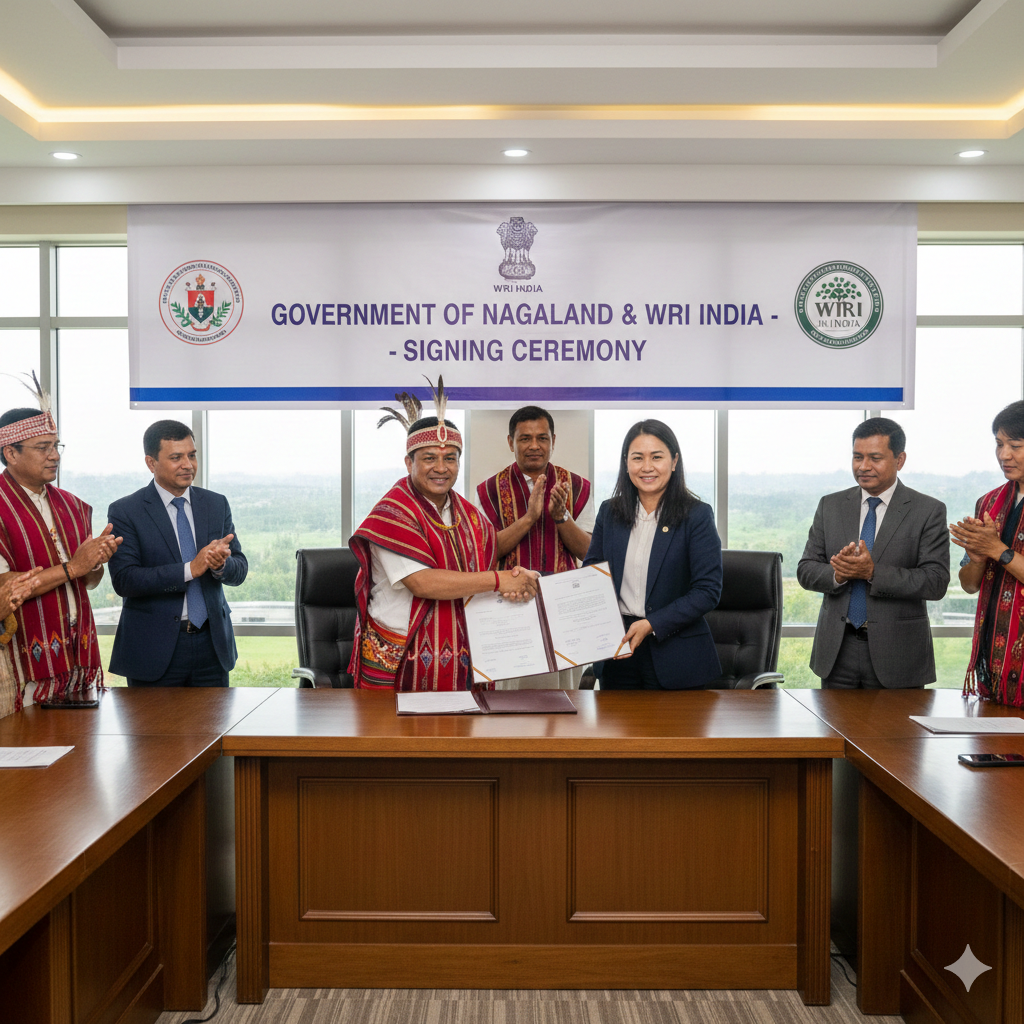
Earlier this week, the Nagaland GIS and Remote Sensing Centre (NGISRSC) entered into a Memorandum of Understanding (MoU) with WRI India to promote clean energy planning in the state in a historic move towards sustainable development.
The agreement is centered on the implementation of the Energy Access Explorer (EAE) platform, which is a digital open source that seeks to determine high-priority regions of renewable energy interventions.
Key Facts
- Date signed: January 7, 2026
- Parties to the contract: NGISRSC and WRI India.
- Granted access: Energy Access Explorer (EAE)
- Goal: Clean energy planning and better energy access, which are data-driven.
- Importance: The first of its kind in Northeast India.
Strategic Importance
The deal between Nagaland and WRI India is a step toward changing the energy transition in the state. The EAE platform will assist policymakers, utilities, and communities to identify areas where a renewable energy source can be used to its full potential with the help of geospatial data. This covers rural and underserved regions where it is still hard to have access to reliable electricity.
The project will be consistent with the larger Indian clean energy ambitions, such as the national objective of 500 GW of non-fossil fuel capacity by 2030 and the national objective of net-zero emissions by 2070.
Benefits of the MoU
- Data-oriented planning: Application of geospatial analytics to determine gaps in energy supply and prioritize interventions.
- Inclusive access: Preoccupy rural and remote communities so that the distribution of energy is fair.
- Policy support: Offers evidence-based policies to state energy policies and decisions on investment.
- Resilience to climate change: Promotes the use of renewable energy and less use of fossil fuels.
Voices from the Partnership
According to the officials of NGISRSC, the collaboration would enhance the capability of Nagaland to plan towards sustainable energy accessibility with the help of modern digital tools. WRI India pointed out the relevance of EAE to eliminate the data gaps and provide energy solutions that are climate-friendly and include everyone.
Conclusion
The MoU between Nagaland and WRI India is an innovative initiative in the clean energy process in Northeast India. Implementing the platform of Energy Access Explorer, Nagaland is going to be a pioneer in data-driven energy planning so that renewable energy may be distributed to the communities that need it most.
Such state-level efforts will be very important in meeting the targets of national sustainability as India steps up its clean energy transition in 2026.
