

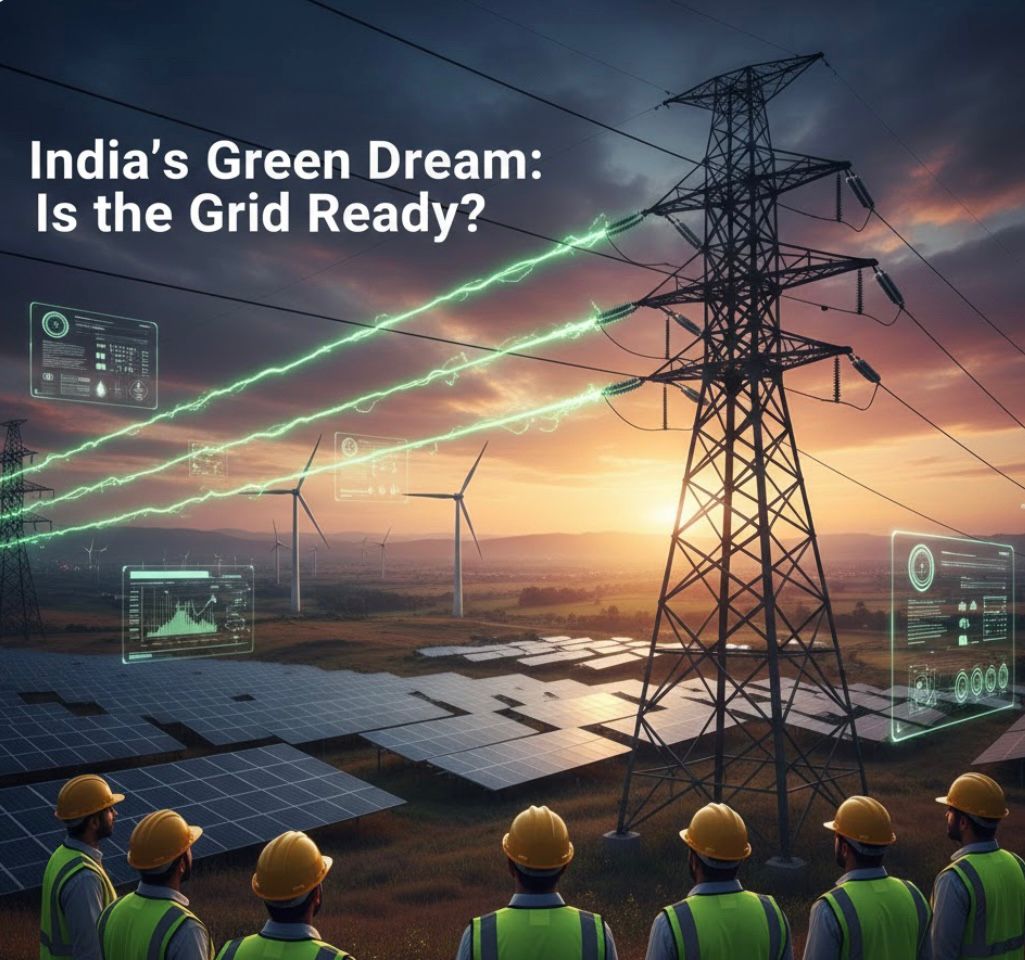
India is building more solar and wind plants than ever before. But the real challenge now is not only producing clean power it is about moving that power from far-off deserts and coastal areas to cities, factories and charging stations across the country.
The government has fixed a very big goal: 500 gigawatts (GW) of non-fossil fuel energy by 2030. This target is important for fighting climate change and making India less dependent on imported fuel. But to make this dream real, India needs a much stronger electricity grid.
A Grid That Is Falling Behind
In the last ten years, India added around 1.8 lakh kilometres of transmission lines, which is about a 70% increase. Still, experts say this is not enough.
The International Energy Agency (IEA) has warned that grid expansion is happening more slowly than the growth of renewable energy. If this continues, many solar and wind plants will not be able to send all the electricity they produce. This means clean energy will be wasted.
The Central Electricity Authority (CEA) says India must invest more than ₹9.15 lakh crore in the coming years to upgrade and expand the transmission network.
What the National Electricity Plan Tells Us
The National Electricity Plan (NEP) says that by 2032 India plans to build more than 1.91 lakh circuit kilometres of new transmission lines and create about 1,270 GVA of transformation capacity.
But it is not only about adding wires. Solar and wind energy do not run all the time. The sun sets, and the wind slows down. So India is also planning to add:
• 47 GW of Battery Energy Storage Systems (BESS)
• 31 GW of Pumped Storage Plants (PSP)
These systems will store electricity when production is high and release it when demand increases, helping to keep the grid stable HVDC: A Game Changer for Long Distance Power
India is also using High-Voltage Direct Current (HVDC) lines. These lines can carry large amounts of electricity over long distances with very little loss.
One big example is the 800 kV HVDC line from Gujarat to Maharashtra. This project will be able to move up to 8 GW of renewable power and is expected to start working by 2026. It will help supply clean energy from western India to regions where demand is high.
The Big Money Problem
All this needs huge money. The government alone cannot pay for everything. So states are being asked to sell or monetise old transmission assets and use that money for new projects.
Regulators are also being told to create better tariff systems so that private companies get steady returns. This will make the power sector more attractive for long-term investors.
India’s green future is not just about building solar and wind plants. It also depends on how quickly the power grid is strengthened.
If the grid improves in time, India can reach its 500 GW clean energy goal and lead the world in green power. If not, weak transmission lines could slow down the entire renewable mission.
