Close Menu
    Advertise With Us
    Facebook X (Twitter) Instagram
    Saturday, March 28
    Advertise With Us
    Facebook X (Twitter) Instagram
    Greenisthefuture
    • Top Stories
    • Renewables
      • Solar Energy
      • Wind Enegry
    • Electric
      • 2 Wheeler
      • 4 Wheeler
      • Battery
      • Charger
      • Infrastructure
    • Clean Energy
    • Eco Innovator
    • Global
    • Interview
    Subscribe Now
    Greenisthefuture
    You are at:Home » India to Incentivize Lithium & Nickel Processing for EV Batteries
    Battery

    India to Incentivize Lithium & Nickel Processing for EV Batteries

    SINDHBAJ KUMARBy SINDHBAJ KUMARJanuary 29, 20262 Mins Read
    Share Facebook Twitter Pinterest LinkedIn Tumblr Email
    Share
    Facebook Twitter LinkedIn Pinterest Email

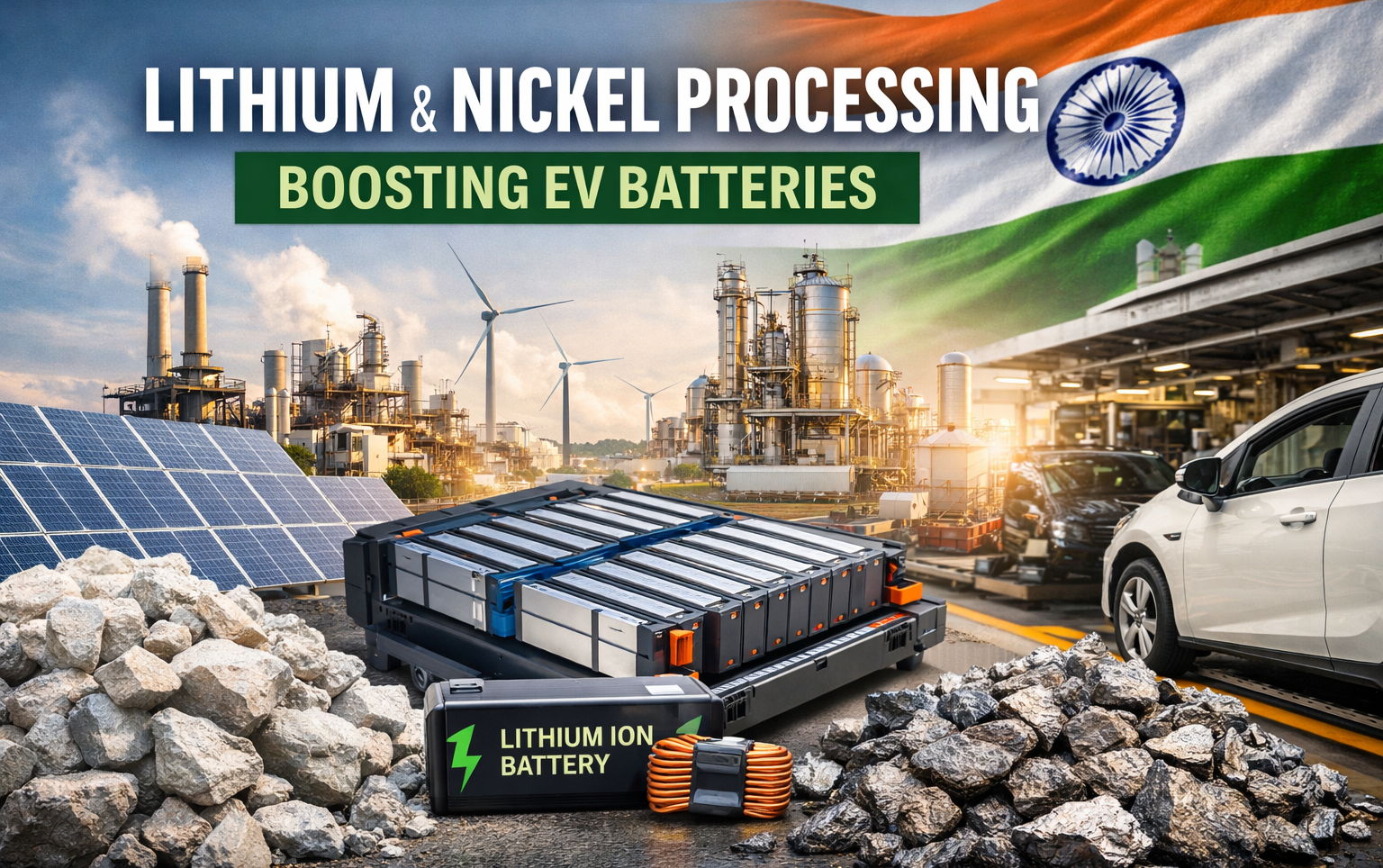
    The Government of India has been considering implementing a large-scale incentive program to facilitate the domestic lithium and nickel processing, which is a key move toward solidifying the country’s battery supply chain of electric vehicles (EVs) and giving momentum to the electric transition.

    Under this scheme, firms that invest in the lithium and nickel processing plants will receive capital subsidies as per a government-subsidized program that will be implemented starting April 1, 2026. The shift will help decrease the reliance on imports, encourage the inflow of private capital, and expedite the technological rapidity in India in the field of processing minerals of the key value.

    Strategic Push of Critical Minerals

    The production of lithium-ion batteries requires lithium and nickel that are used in electric vehicles and power storage systems.

    Presently, these mineral processing capacities have been concentrated outside India, particularly in China. To overcome this loophole, the incentive scheme offers a 15 percent capital tax deduction on qualifying investments in qualifying lithium and nickel planting.

    Following the proposal, an incentive will be offered for a period of up to five years, capped based on the net sales turnover, whereby 40% goes to lithium processing units and 25% to nickel facilities.

    It should qualify on the basis of the minimum processing capacity of 30,000 metric tons in the case of lithium plants and 50,000 metric tons in the case of nickel plants.

    Rollout and Utilization Phased Targets

    The subsidy will be paid in installments, depending on the attainment of the utility standards established by the government. The preliminary arrangements within the scheme aim at establishing two lithium and two nickel operations to cater to the domestic demand rise up to the year 2030.

    Advancing E-Vision in India

    Such a motivation plan and scheme is in tandem with the wider objectives of India to move to clean mobility. The country has fixed high goals of 30 percent penetration of electric cars and 80 percent penetration of electric two-wheelers by 2030, against the 4 percent and 6 percent today, respectively.

    Analysts believe that the new policy will lead to major investments in battery material infrastructure, reduce the cost of imports, and increase employment in high-tech manufacturing, empowering the country in the international EV supply chain.

    battery manufacturing clean energy India Critical Minerals electric vehicles energy transition EV Batteries Government EV Adoption India EV Policy lithium processing nickel processing
    Share. Facebook Twitter Pinterest LinkedIn Tumblr Email
    Previous ArticleNTPC Green Energy Enters 8,400 MW Milestone With New Gujarat Solar Plant.
    Next Article Telangana Amends Open Access Electricity Rules to Aid Power Consumers
    SINDHBAJ KUMAR

    Related Posts

    Budget 2026: Government Extends Duty Relief for Battery Manufacturing, Cheaper EVs on the Horizon

    February 1, 2026

    EV Truck Battery Swapping Boosts Electric Logistics

    January 31, 2026

    Fraunhofer ISE Unveils 3 kV Next-Gen Solar Inverter for Utilities

    January 30, 2026
    Add A Comment
    Leave A Reply Cancel Reply

    Top Posts

    BCCI’s Green Pitch for Sustainable Cricket Future

    February 16, 2025

    Global Push for Sustainability Drives Green Ammonia Production

    March 18, 2025

    WPL 2025: Cricket Scores for Sustainability, Too!

    March 14, 2025

    Delhi EV Policy 2.0 Targets 95% Electric Vehicles by 2027

    March 11, 2025
    Don't Miss

    India Enhances International Connections to Increase Renewable Energy and Grid Storage

    By Aditya PandeyFebruary 3, 2026

    The Indian government is increasing its quest to forge international collaboration in renewable energy, green…

    Budget 2026 prolongs EV Manufacturing industry

    Caliber Interconnects Secures ARAI Certification, Boosting India’s EV Charging Infrastructure

    Mercedes-Benz Confirms CLA EV Launch in India for April 2026

    Newsletter

    Subscribe for Updates

    Get the latest updates from GreenIsTheFuture

    About Us

    Green technology can be used to reduce pollution and waste products of traditional industrial processes. In addition to reducing the negative effects on the natural environment, these technologies can also use resources more efficiently.
    Email Us: info@greenisthefuture.in

    Facebook X (Twitter) YouTube WhatsApp
    Quick Links
    • About Us
    • Our Team
    • Privacy Policy
    • Advertise With Us
    • Terms & Conditions
    • Subscription
    Newsletter

    Subscribe for Updates

    Get the latest updates from GreenIsTheFuture

    © 2026 Designed by GreenIsTheFuture.

    Type above and press Enter to search. Press Esc to cancel.