

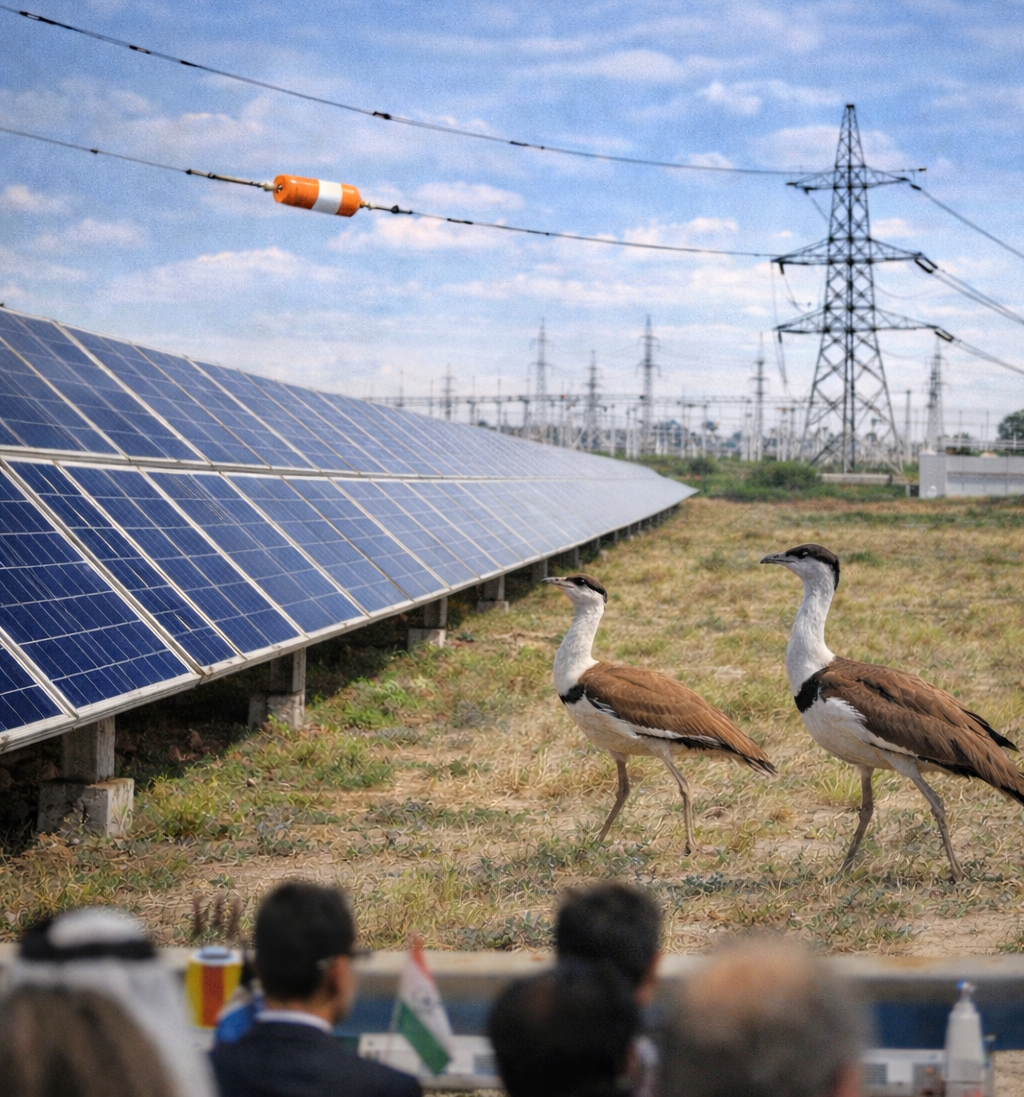
The Government of India has given more time to a number of solar power projects that were put on hold because of the restriction on conserving birds. The relocation comes to the rescue of renewable energy developers who incurred legal and environmental challenges, especially in areas where wildlife protection orders have been imposed. The ruling would aim at striking a balance between the clean energy development in India and the necessity to protect threatened species of birds.
Effects of Wildlife Protection Orders
A couple of solar and wind power plants in western India, particularly in Rajasthan and Gujarat, have been affected when the courts had to issue orders limiting some work so as to protect the endangered Great Indian Bustard. These orders demanded undergrounding of the overhead transmission lines within important habitats as a way of avoiding collision by birds. This ultimately led to project schedules being upset and the costs being inflated.
Government permits force majeure extensions
To overcome such delays, the Ministry of New and Renewable Energy has approved a time extension under the provisions of the force majeure. It implies that developers will have no punishment or loss of power buying agreements because of slowdowns to comply with court orders related to conservation. The extension is only applicable to projects that are really impacted by wildlife protection initiatives.
In favor of clean energy targets
India has also made the bold target of reaching 500 gigawatts of non-fossil fuel by 2030. Solar power is at the focus of achieving this target. The government officials indicated that although environmental protection is paramount, time wastage by the government beyond the hands of developers must not derail the clean energy transition in India but not turn away investors in the sector.
Striking the right balance between ecology and development
The ruling remarks on the attempt of India to create a compromise between environmental conservation and infrastructure production. Experts emphasized that development of renewable energy has to be done sustainably. It is being encouraged to minimize the environmental impact by using measures like bird diverters, the use of underground cabling in the sensitive areas, and better planning of projects.
Reaction of Industry and Investor Confidence
This move was welcomed by renewable energy developers who claimed that it offers regulatory and financial relief. According to the industry observers, the extension of deadlines is without which most of the projects were likely to be unsustainable. The move by the government is likely to revive the confidence of the investors and make available those projects that have already been in construction to proceed.
Renewable Expansion Way Forward
The government indicated that it will carry on with environmental agencies, state government, and developers in developing long-term solutions. By linking the conservation agenda to climate policies, India seeks to show that climate action and biodiversity protection could move side by side.
