

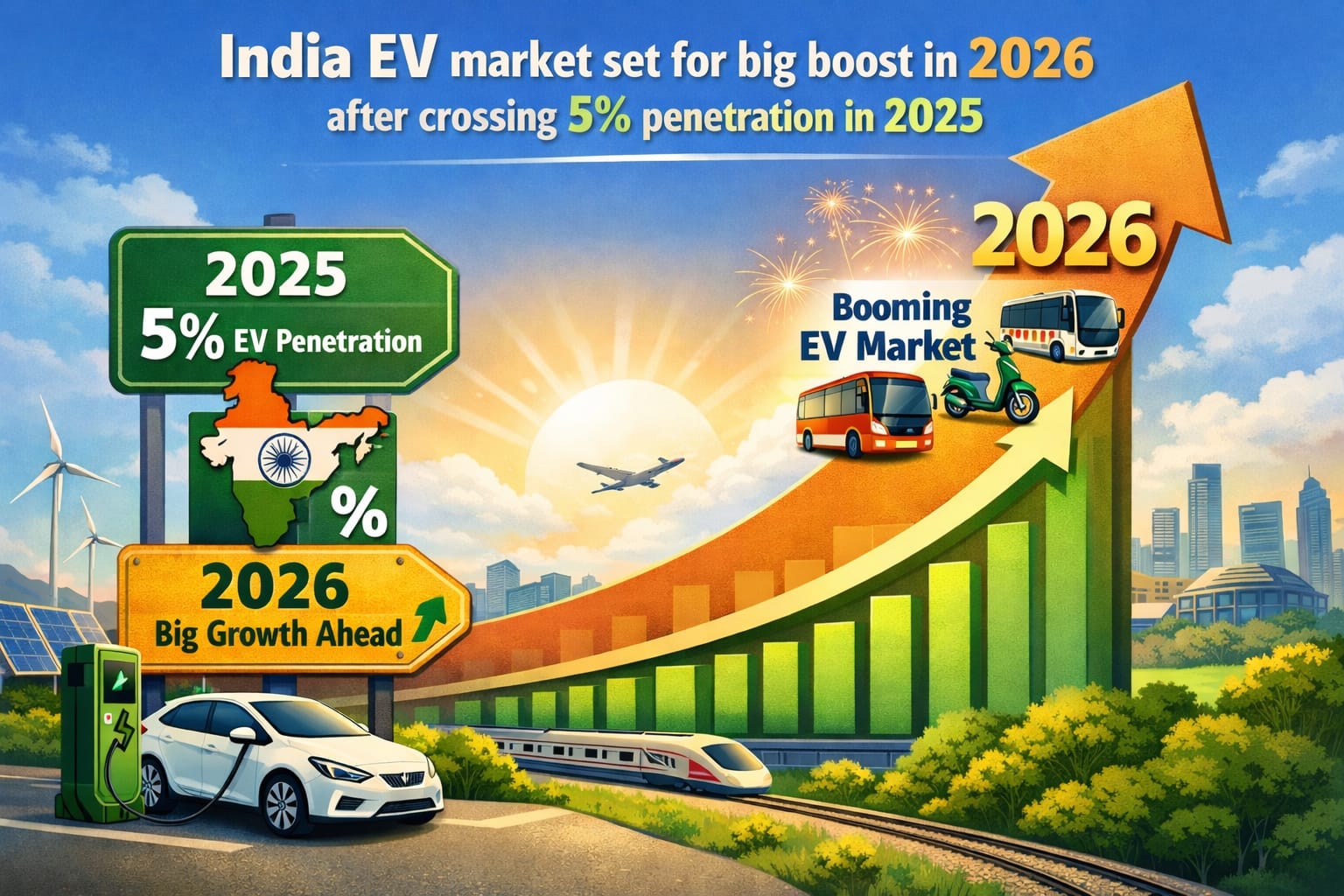
In 2025, the electric vehicle (EV) market in India had reached a significant milestone, where a total of more than 5% of passenger vehicles had been penetrated. Although the two-wheelers continue to be at the tip of the adoption, the market is currently diversifying extremely fast into the four-wheeler market, indicating a global change in mobility.
EV Penetration Crosses 5% in 2025
As per industry data, the penetration of EVs in India will be at 5% in 2025, which is a turning point in the clean mobility process in India. This was mainly driven by electric two-wheelers, which registered 127,000 units as of 2025, as compared to 1.14 million in 2024.
With a high demand for its iQube line, TVS Motor dominated the two-wheeler EV market with a market share of 23.5 percent.
Bajaj Auto claimed the second place, and Ola Electric and Ather Energy also gained their positions with family scooters and performance-oriented models.
The growth of the segment indicates the confidence of consumers in EVs as affordable, reliable substitutes for petrol scooters.
Four-Wheeler Expansion Continues to Gather Steam
Although the volumes are dominated by two-wheelers, the current frontier of growth is now being entered by electric four-wheelers. By 2025, the sales of EV cars exceeded 1.7 lakh units, which is almost twice the sales in 2024.
Tata Motors also dominated with its EV models such as the Nexon EV, Punch EV, and Tiago EV, with a market share of more than 40 percent.
Mahindra Electric and JSW MG Motor launched new SUVs, and VinFast entered India with aggression, outselling the established brands such as BMW and Kia in December 2025.
Future models such as the Tata Sierra EV, Hyundai Creta EV, and Maruti Suzuki eVX, which also will start in 2026, are likely to further boost adoption.
Infrastructure and Policy Support
Affordability keeps on being fueled by government incentives under FAME-II and state EV policies. Simultaneously, the infrastructure of charging is growing, with the fast-charging networks being deployed at metros and highways. Analysts observe that the battery-swapping model is also to be experienced by two-wheelers, which will take care of range anxiety and also minimize downtime.
Market Outlook
Analysts estimate that the EV penetration will be 10% in 2027, with two-wheelers prevailing, but four-wheelers will play a significant role in the growth of the market. The idea of the dual expansion is an indication of the changing consumer base in India, where the urban commuters are switching to scooters and the families and professionals are embracing the use of electric cars.
The 5 percent penetration target in 2025 is a highlight of the shift of India towards niche adoption and mainstream acceptance. The EV market is estimated to grow in the next years with the double-digit growth, which is projected to be supported by the substantial OEM involvement, advantageous policies, and increased consumer interest.
Analysts forecast that India’s EV penetration could rise to 7–8% in 2026, setting the stage for double-digit adoption by 2027. The dual expansion of two-wheelers and four-wheelers ensures that both urban commuters and family buyers will contribute to this growth.
