

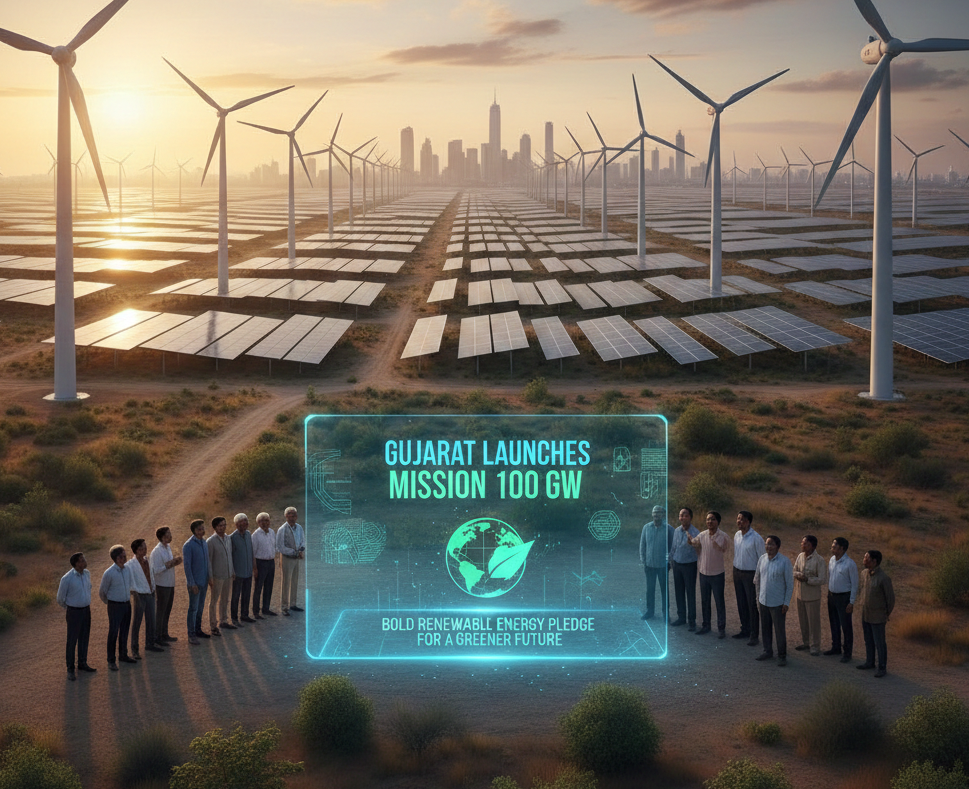
It is one of the historic announcements made by Prime Minister Narendra Modi in the Vibrant Gujarat Regional Conference today, during which he announced the ambitious Mission 100 GW (Shapath Patra) of the State of Gujarat, which has pledged to establish a renewable energy capacity of 100 gigawatts within the next several years.
The project will make Gujarat the leader of the clean energy revolution in India as part of the national climate action.
The announcement highlights that Gujarat is a leader in the industry of renewable energy in India. The state is already home to some of the largest solar and wind projects in the country and is looking to add more projects on solar parks, offshore wind farms, and green hydrogen projects.
It is projected to bring billions of domestic and foreign investment into the state due to the Mission 100 GW roadmap that will generate jobs and decrease the reliance on fossil fuels.
Major Highlights of the Mission
- Capacity goal: renewable energy—100 GW solar, wind, and green hydrogen.
- Industrial estates: 14 new greenfield GIDC estates to help in manufacturing clean energy.
- Rajkot Medical Device Park: Complementary infrastructure to enhance innovation in healthcare and energy projects.
- Global collaboration and global partnerships: There are more than 1,500 MoUs anticipated during the conference, and most are aimed at sustainable energy.
- National alignment: Enhances the Panchamrit target of India—500 GW of non-fossil fuels by 2030—and the net-zero emission target by 2070.
During the inaugurations, PM Modi stressed that Gujarat has the commitment to ensure that the economic development of the region is balanced between the need to be responsible and to protect the environment. It is not only a target, he said, but a promise to the future generations, and innovation, startups, cooperation, and global collaboration are those facets of achieving this purpose.
Impact and Challenges
As the experts observe, the mission has the potential of making Gujarat a center of global renewable energy and green hydrogen, and it will solidify India on the global climate front. The project will mean a cleaner environment, less carbon content in the air, and industrial development that is sustainable.
But there are still issues like how to incorporate intermittent utility of renewable supply into the grid, how to increase the use of hydrogen technology, and how to maintain the development of the regions on a level playing field.
Nevertheless, the obstacles have not damped off the Mission 100 GW of Gujarat, which has become a celebrated move towards a greener planet. The state, with substantial political goodwill, industry involvement, and international cooperation, is ready to spearhead the transformation of India to clean energy and become the role model for other countries.
