

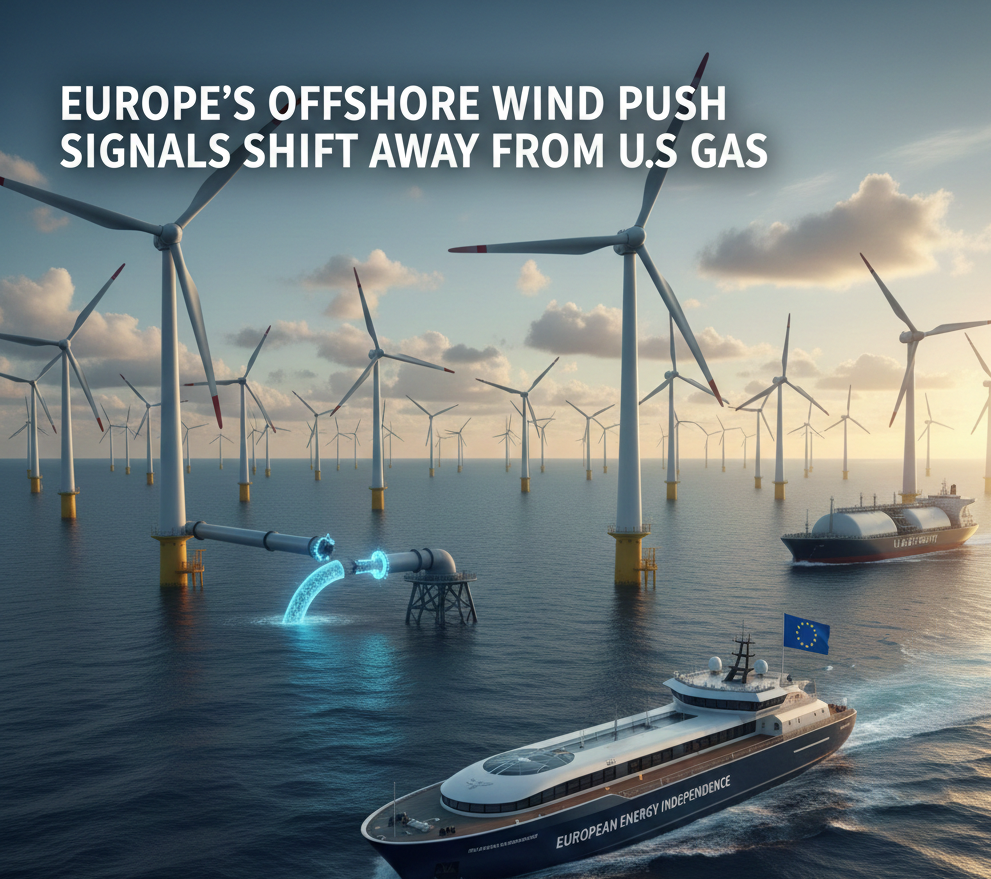
European countries have struck a significant offshore wind deal which is commonly regarded as hedge against excessive dependence on gas imports in the United States. The nine countries who signed the agreement at the North Sea Summit were the UK, Germany, France, Belgium, Denmark, Netherlands, Ireland, Luxembourg and Norway and this emphasizes a coordinated effort to enhance the energy security of Europe by relying on renewable power.
Ambitious Capacity Targets of the Offshore Wind.
Within the agreement, the countries involved had an obligation to build up 100 gigawatts (GW) of offshore in the North Sea over the next several decades. That is part and parcel of Europe overall aiming to achieve the offshore wind capacity of at least 300 GW by 2050, which would power the electricity needs of over 300 million European households, as estimated by the industry.
The third strategy, which is equally important, involves decreasing the reliance on the U.S. LNG imports.
This move comes at the time when Europe has increased its reliance on the U.S. liquefied natural gas (LNG) with the interference of Russian gas supply. By the year 2025, U.S LNG contributed approximately 57 percent of the total LNG imports in EU and UK, which posed a risk to the price fluctuations and geopolitical risks. Domestic renewable energy is increasingly being considered by policymakers as a safer long term alternative.
There are several advantages of extending wind, economically and in cost.
According to industry body Wind Europe, the offshore wind development process can lower the system costs by a total of up to 30% by 2040 on a coordinated basis. The project also has the potential to achieve close to a trillion of economic activity and enable more than 90,000 direct and indirect employment especially in coastal areas and large manufacturing centers.
The cross-border grid and energy integration plans are considered to be cross-border.
One of the main characteristics of the agreement is the intention to build the offshore grids across the borders, so that electricity can be shared between nations. As a means of reducing the congestion and having a balance in the supply and demand of the wind, Europe seeks to link wind farms to several markets as a way of enhancing grid resilience across the national boundaries.
The implication of the events on Geopolitics and Climate.
Although LNG has become very important in the short-term stability of energy, the leaders of Europe emphasize that excessive reliance on a single supplier poses risks in the long-term realities. The offshore wind agreement not only strengthens the commitments by Europe on climate matters but also sends a strong message to the world that their future energy security will be based more on home-grown renewable energy sources than on imported fossil fuels.
