

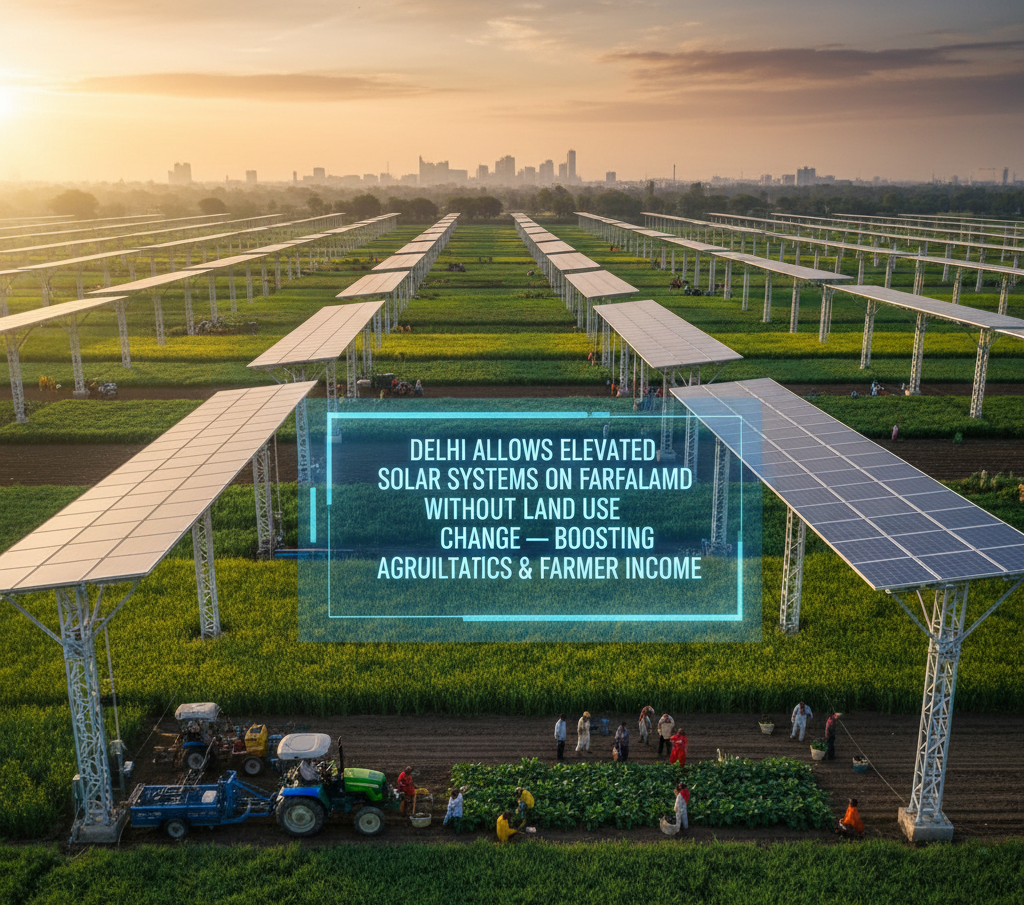
The government of Delhi has also allowed installation of the elevated solar power systems on agricultural lands without any formal land use change, which is a major policy change with an intention to increase the clean energy implementation. The relocation allows the farmers and developers to install the solar panels on raised platforms, after which crops can be grown under them. The elimination of the requirement of land-use conversion will help authorities to reduce delays, cut compliance, and open up idle potential on peri-urban and rural land.
Farming and Power Generation may Coexistence.
High-altitude solar taller systems are known as agrivoltaic which is meant to balance between agriculture and electricity production. Installation of panels at a good height ensures that there is no major impact on the amount of sunlight spreading to the region, access of irrigation and movement of farm machines. According to authorities, the model assists farmers to diversify the income sources by leasing them or selling power and at the same time retain the agricultural productivity. It is also found to be beneficial to climate resilience through the decrease of heat stress on some crops and enhance water-use efficiency
The farmers and developers were relieved of regulations.
Earlier on, to install a solar project on farm land a land-use change would have to be done and that would entail a number of clearances and time-consuming approvals. The new strategy sees higher solar installations as agricultural compatible, and the conversion is not necessary. This deregulation will encourage the entry of the privately owned funds, facilitate the implementation of projects, and the willingness of small and medium farmers to engage in the process without the fear of losing the status of an agricultural activity.
Clean Energy Targets and Grid Support
.
The move by Delhi is in line with the national objectives of the expansion of renewable capacity and decarbonization of the power mix. High-solar on farmland can be utilized to achieve distributed generation to relieve pressures on the urban grids and minimize the contagion losses in the transmission lines. The policymakers are of the opinion that the measure will aid in scaling solar capacity with limited land area besides facilitating peak demand management
Implementation, Protections and Forecast.
The government has pointed out that the projects should comply with safety, structural and environmental standards such as having sufficient clearance heights and minimum disturbance to the soil. With guidelines coming out, stakeholders anticipate a tidal onslaught of pilot projects and public-private partnerships. The reformation makes Delhi a pioneer in agrivoltaics, which is a combination of welfare of the farmers and development of clean energy.
