

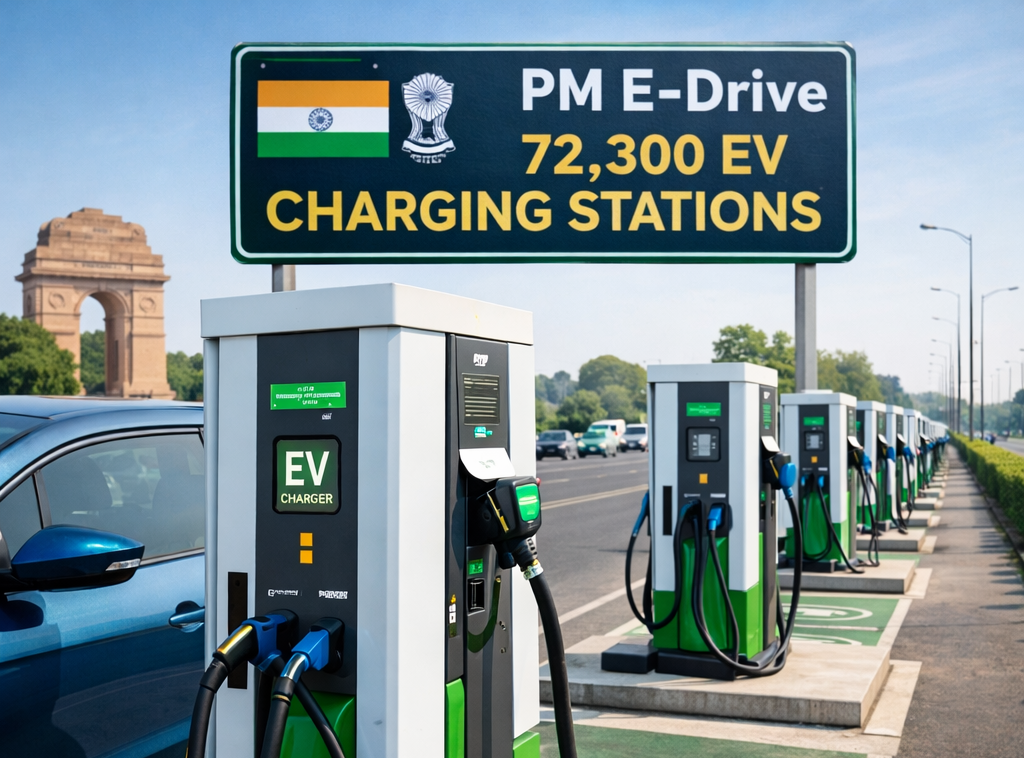
To accelerate the scaling up of electric vehicle (EV) charging infrastructure, the Government of India has also published elaborate operational specifications on the implementation of the 10,900 crore PM E-Drive scheme under the umbrella scheme. The project seeks to install as many as 72,300 public EV charging, battery swapping, and supporting infrastructure throughout the country, which would be one of the most recent large-scale charging rollouts in the country, by the Centre.
The PM E-Drive Scheme aims at a swifter EV adoption
The PM E-Drive initiative is significant to the overall electric mobility policy in India, as it represents the solution to one of the most significant obstacles to EV adoption, i.e., range anxiety. Under this program, the government is aiming at having wider and more consistent accessibility to charging infrastructure in urban centers, highways, industrial areas, and high-traffic public areas. The scheme provides assistance to both personal and business EVs, such as two- and three-wheelers, passenger vehicles, and electric buses.
Massive grants to expand the use of chargers
The guidelines offer capital subsidies of between 80 and 100 percent on the implementation of charging infrastructures based on the type and location. It will prioritize public charging stations, fast DC chargers, and battery swapping units with increased incentives, particularly in highly populated areas like highways and underserved areas.
These economic stimulation packages are designed to bring in new players in the form of private operators, energy firms, and even state institutions to join the large-scale implementation.
Target Cities, Roadways, and Strategic Everything
The government also intends to strategically position charging stations in metro cities, Tier-2 and Tier-3 towns, on national highways, expressways, transport hubs, and government premises. The levels of charging will be interesting for long-distance EV travel using highway charging corridors and convenient daily charging using dense urban networks.
Commercial fleets and last-mile delivery vehicles will be served with battery swapping stations and will not have to spend as much time charging their batteries.
Participation of the Weight in the private sector and Standardisation
The guidelines stress the idea of public-private partnerships (PPP) and standardized charging protocols to assure safety and interoperability. The charge operators are required to meet technical requirements on chargers, software, and grid connection. Such a practice will assist in developing a coherent and convenient EV charging system on interstate and inter-regional levels.
Enhancing the Clean Mobility in India
The PM E-Drive guidelines can be considered a key driver to the EV ecosystem in India, according to the industry experts. A national stature of infrastructure scaling up of charge stations will increase the investor confidence as well as encourage local production of chargers, power electronics, and energy management systems. The project is also supposed to create more jobs and increase the use of clean energy.
India is making a strategic move towards using electric vehicles, which is more convenient and mainstream as it implements 72,300 EV charging and swapping stations, creating a cleaner and more sustainable transportation electric future.
