

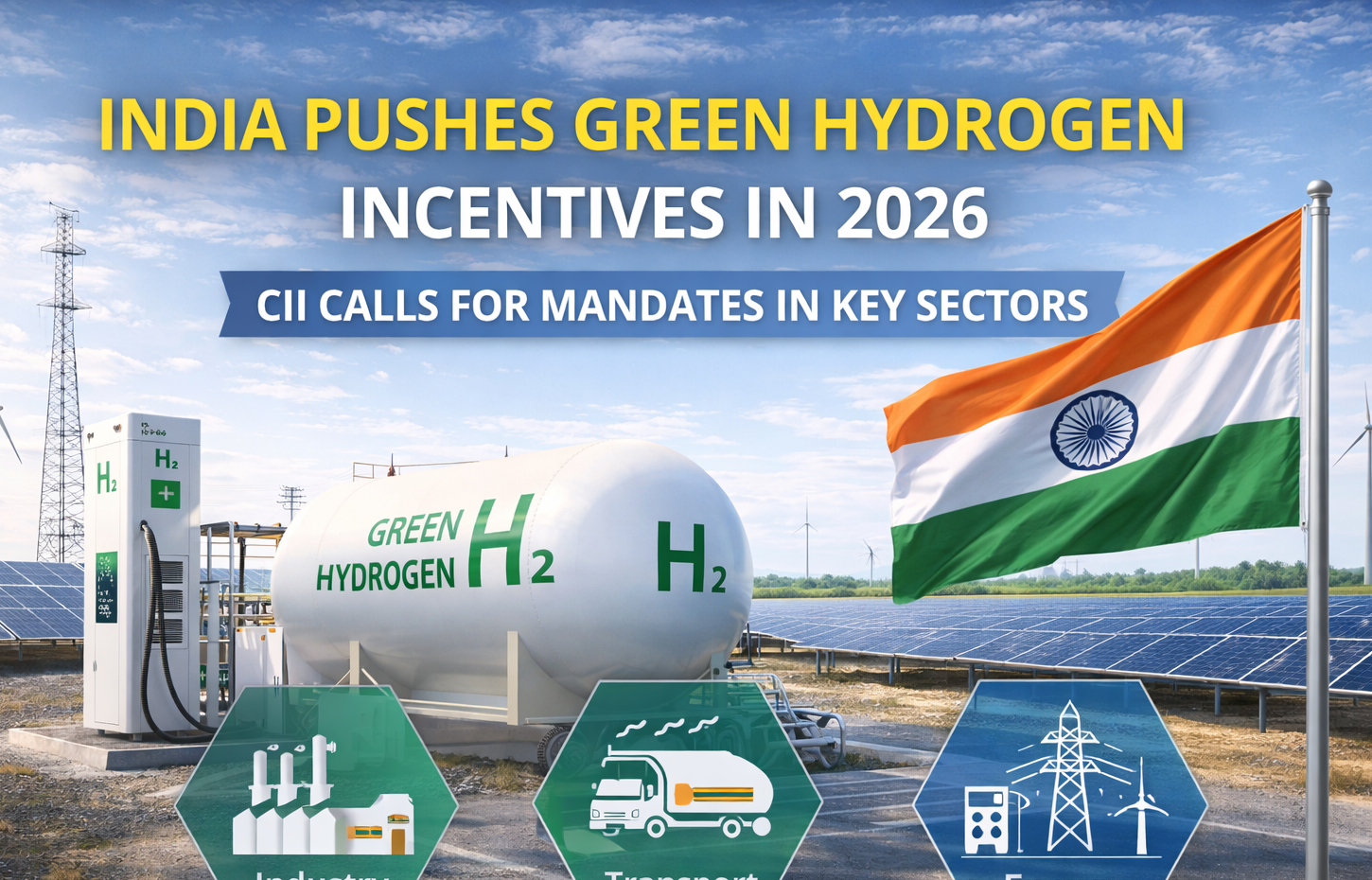
The Confederation of Indian Industry (CII) has made calls on the government to initiate the blending of green hydrogen. The appeal is made in January 2026, when India hastens the shift to clean energy.
CII’s Proposal
CII requested the policymakers to target the refining, fertilizer, and natural gas industries. Grey hydrogen is currently extensively depended on in these industries and is produced with the help of fossil fuels. Renewable energy produced into green hydrogen is still more costly.
CII emphasized the necessity of cost-offset mechanisms. These would contribute to the reduction of the price difference between the green and grey hydrogen. Industries will be reluctant to use more environmentally clean methods without incentives.
India’s Climate Goals
India is targeting to be one of the leaders of green hydrogen energy and consumption in the world. The government has already introduced the National Green Hydrogen Mission. The mission is aimed at producing 5 million tonnes of green hydrogen per year in the year 2030.
By 2026, the renewable energy capacity in India had already surpassed 200 GW, and the basis of large-scale hydrogen production had been created. Green hydrogen is regarded as essential towards the realization of the 2070 net-zero emissions promise.
Industry Impact
- Refining industry: Green hydrogen can substitute grey hydrogen in the refining of oil.
- Fertilizer business: The production of ammonia can be changed to green hydrogen, whereby practicing emissions are lowered.
- Blending natural gas: Green hydrogen has the capacity to reduce the level of carbon in the pipeline.
According to CII, the mandates will have demand. Adoption will be financially viable through incentives. Their collaboration can speed up the hydrogen economy of India.
Global Context
Asian nations such as Japan, Germany, and Australia are putting a high investment in green hydrogen. India would like to establish itself as a competitive supplier. India has the naturally fortuitous advantage of having plenty of solar and wind energy.
Challenges Ahead
The greatest challenge is high costs of production. Storage and transport facilities are also still scarce. The following stage will require policy clarity and financial support.
Conclusion
In 2026, the green hydrogen push by India indicates its intention to be the energy leader in the world. Green hydrogen has strong industry backing and is supported by the government, so it would not take long before the refining, fertilizer, and natural gas sectors of India rely on green hydrogen, taking the country a step closer towards meeting the national climate targets.
