

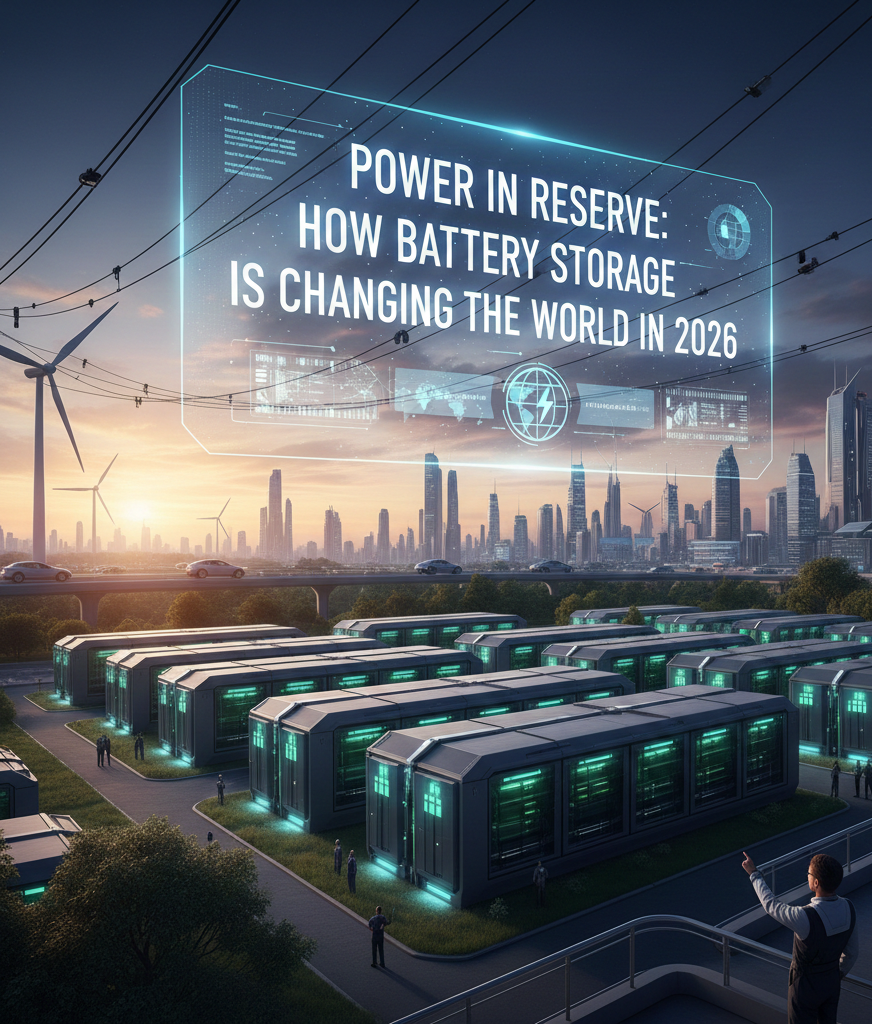
Renewable energy like solar and wind is growing extremely fast around the world. But sunlight only shines in the day and wind doesn’t always blow. That means power supply can be unpredictable. Because of this, big battery storage systems have become crucial. These batteries store extra electricity generated during sunny or windy hours and release it later when electricity demand is high — for example, in the evening or at night. This helps prevent power cuts and ensures clean energy is not wasted.
India Builds Mega Battery Projects
India is now increasing rapidly for building the large battery storage plants to make its renewable energy more reliable.
In 2025 India had a relatively small storage capacity, around 507 megawatt-hours (MWh) — enough to power about 50,000 homes for an hour — but in the year 2026 this is expected to jump nearly tenfold to about 5 gigawatt-hours (GWh), thanks to major projects and policy support.
States such as Rajasthan, Gujarat and Tamil Nadu are setting up grid-scale batteries near big solar and wind parks. These systems will help provide stable electricity even at night and during grid stress by releasing stored power when needed.
Experts also estimate that by 2031–32 India may need over 80 GWh of storage capacity to support its huge renewable goals
America And Europe Lead Energy Storage Growth
Europe is moving very fast in the field of battery storage. Europe has already installed tens of gigawatt-hours of battery capacity in many countries . and this is growing every year. Countries like Germany, Spain and the UK are investing heavily to reduce blackouts and support more clean energy from solar and wind. In the year 2025 many new renewable energy and battery project are approved in Great Britain . globally the battery storage are increasing very fast . in the years 2025 only lots of new batteries added 90+ GW of power, which is around 247 GWh of stored energy. there is big difference that shows the last few years ago
Asia and Africa Join The Storage Revolution
In Asia, there are many countries like Japan and South Korea are focusing on making the advanced battery technologies that can help the nation, especially in manufacturing high-performance lithium-ion cells.
In Africa, there are many countries such as South Africa and Kenya are using battery storage to support rural communities across the nation and reliable electricity to the people of rural area far from the main grid.
Across the Asia-Pacific region — there are many countries such as China, India, Japan and Australia — in this region you can find around 37% of the world’s installed battery storage .
Challenges Still Remain
Even though battery storage is growing so fast still there are some problems are left such as –
High cost:
The cost of the big battery systems are still very costly . In the last 10 years Prices have fallen, but they are not cheap enough for make many small projects. Because of this, many clean energy plans depend mostly on the government support.
Recycling problem:
Recycling old lithium-ion batteries is very difficult and costly . Proper recycling systems still not well developed, there are lots of expert are working on it and if batteries are thrown away, they can harm the environment and the world
The Road Ahead
Even with the lots of challenges . the years 2026 is showing how the batteries the backbone of clean energy. when the technology improves the costs will also fall. the clean electricity will available all the times . lots of experts say that by 2030–2035, global energy storage could grow many times more, reaching hundreds of gigawatts or even terawatt-hours, that is enough to give power to whole countries. This will completely change how the world produces and uses electricity
